
On the morning of September 9, 2026, Julia was buying luggage. She had lived in the United States since she was ten years old — nearly three decades — and she had purchased a plane ticket to a country she barely remembered. “I have one hour to get out of the Titanic before it sinks,” the thirty-seven-year-old told me. That day was supposed to mark the expiration of Temporary Protected Status for more than a hundred and seventy thousand Salvadorans, a legal designation that had allowed them to live, work, and build lives in the United States without fear of arrest or deportation. The Trump administration had given every signal it intended to let that status die. The termination memo had been drafted. Notices to beneficiaries were queued at the printer. And then — nothing. The deadline passed in silence, replaced only by a cryptic line posted to the Department of Homeland Security’s website: “An announcement on El Salvador’s TPS will be made at the appropriate time.”
Three weeks on, no announcement has come. The administration has offered no public explanation, no timeline, no reassurance. What has emerged instead, through interviews with former DHS officials, immigration attorneys, labor advocates, and the T.P.S. holders themselves, is a portrait of a policy decision frozen mid-execution — not out of compassion, not out of legal constraint, but almost certainly because powerful economic interests made a sufficiently compelling case to the White House that canceling Salvadoran T.P.S. right now would hurt the wrong people.
To understand what is at stake, it helps to understand what T.P.S. actually is and what it has meant to the people who hold it. Congress created the program in 1990 as a humanitarian mechanism: when a country suffers a catastrophic event — war, earthquake, epidemic — its nationals already present in the United States can receive temporary legal protection rather than face deportation back into chaos. El Salvador was the first country designated, near the end of its brutal twelve-year civil war. A 2001 earthquake prompted a new designation. Over the following two decades, as Congress repeatedly failed to reform the immigration system and provide T.P.S. holders a path to permanent residency, both Republican and Democratic administrations kept extending the designations, year after year, until “temporary” became a word that described a legal category rather than anyone’s actual circumstances.
Eva came to the United States from El Salvador in 1995, at fifteen. She received T.P.S. in 2001, shortly after marrying, and the effect was immediate and transformative. “We started to be counted in the system,” she told me. Living in Florida, where undocumented residents could not obtain driver’s licenses, she had been effectively invisible. T.P.S. gave her a Social Security number, a license, a mortgage, a car. She had a son, then a daughter. She understood perfectly well that her status was technically temporary. But she also understood something that immigration hard-liners prefer to ignore: human beings cannot organize their lives around permanent uncertainty. “Imagine if, year after year, I said, ‘I’m not going to buy a car because I have a temporary status,'” she told me. “No one can live like that.” By 2010, she had lived in the United States longer than she had lived in El Salvador.
Trump tried to cancel Salvadoran T.P.S. once before, in 2018. Legal advocacy groups sued, and a federal court found the administration had failed to follow adequate administrative procedures. The reprieve was real but partial. The following year, Eva’s husband — who lacked T.P.S. — was deported. She stayed. Her children stayed. And as this past September’s deadline approached, she sat her daughter down and explained that they faced two options: the daughter could follow Eva to El Salvador, a country she had never visited, or she could move in with her older brother, who would need to become her legal guardian. “I don’t want the same thing to happen to them that happened with their father,” Eva told me.
That it did not — at least not yet — appears to have had very little to do with the administration’s concern for Eva or her children. According to multiple former DHS officials with close ties to the department, the memo formalizing the termination of Salvadoran T.P.S. had been prepared more than a month before the September 9th deadline. It was sitting on the desk of Markwayne Mullin, the Secretary of Homeland Security. “On the DHS side, everything was done and ready,” one former official told me. “The Secretary had no reason to sit on it unless the White House told him to.”
The White House told him to. That much seems clear. What is less clear — because the administration refuses to say — is precisely why. The most credible explanation points not to any sudden humanitarian impulse but to a collision between two factions that have defined immigration policy throughout Trump’s second term. On one side sits Stephen Miller, the president’s top domestic-policy adviser, who has pursued the cancellation of legal immigration in virtually every form, treating T.P.S. as an affront to his nativist vision regardless of economic consequences. On the other side sits a more traditionally Republican, pro-industry contingent that has repeatedly tried — and mostly failed — to limit the damage that Miller’s agenda inflicts on American employers.
That internal tension has surfaced repeatedly. In the summer of 2025, a top Immigration and Customs Enforcement official instructed agents to pause worksite enforcement operations at agricultural facilities, restaurants, and hotels — a pause that followed an appeal from Agriculture Secretary Brooke Rollins and promptly drew fire from the far-right base. Last week, Republican legislators from Kansas, Oklahoma, and Texas publicly urged the administration to ease immigration arrests on cattle ranches, warning of rising beef prices. The pattern is consistent: industry lobbies, the White House hesitates, the hard-liners attack, and the policy muddles forward in a state of managed incoherence.
The Salvadoran case introduced a variable that proved harder to dismiss. The Washington metropolitan area is home to the second-largest Salvadoran population in the country — upward of two hundred thousand people. When Trump attempted to cancel T.P.S. in his first term, a fifth of all construction workers in the district held that designation, and most of them were Salvadoran. The construction industry, heavily dependent on that labor force, lobbied aggressively for a pause. Julio Palomo, the business manager of a D.C.-area labor union, put the stakes plainly: “There’s so much construction, so many government contracts, because it’s D.C.”
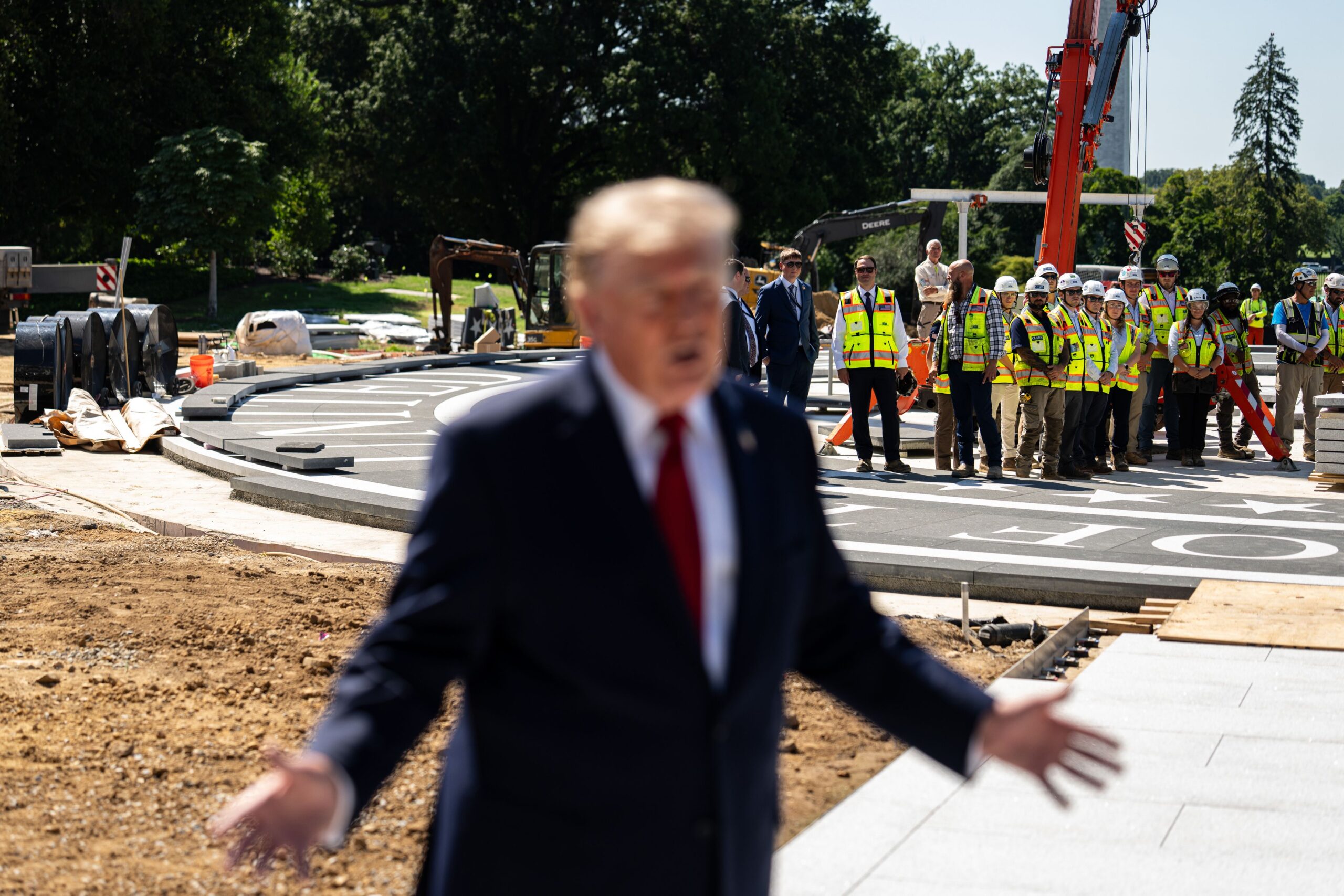
Among the projects currently underway in Washington is a new presidential ballroom, being built by Clark Construction, a firm that employs a significant number of Salvadoran T.P.S. holders. Clark’s spokesperson told me that T.P.S. workers “have not been involved in the construction of the ballroom” and that their status “does not have an impact” on it. A White House official offered a similar denial, specifying that no T.P.S. holders are working on the East Wing modernization project. Yet three sources with direct knowledge of the situation told me that the White House had been explicitly warned that canceling Salvadoran T.P.S. would disrupt construction projects across the capital. The denials and the warnings are not necessarily incompatible. What matters is that the warning landed.
The evidence that it did is visible in the DHS website update posted at the end of September 9th, specifying that Salvadorans with T.P.S. should “retain protection” pending further announcement. A former DHS official told me the clarification was driven by employer demand: companies needed explicit confirmation that continuing to employ T.P.S. holders would not expose them to legal liability. “It’s unprecedented that the government would make a statement like this without a formal decision,” the official said. The government had, in effect, issued a non-announcement — a pause dressed as a placeholder, designed to reassure employers while leaving T.P.S. holders in legal limbo.
Foreign policy played a role as well. El Salvador’s authoritarian president, Nayib Bukele, has cultivated a close relationship with Trump, built in part on his success in dismantling violent street gangs and rebranding El Salvador as a model of muscular governance. Bukele has been reluctant to publicly champion T.P.S. — doing so would undercut his narrative that El Salvador is now safe — but he has also been acutely aware that nearly a quarter of his country’s economy depends on remittances sent by Salvadorans living in the United States. Forcing nearly two hundred thousand of them to return would be an economic catastrophe. According to Politico, the Salvadoran government quietly advocated for more time. Trump, who has shown a consistent willingness to reward allies and punish adversaries regardless of formal policy, appears to have listened.
None of this adds up to a reprieve. It adds up to a delay. Jessica Bansal, an attorney for the National T.P.S. Alliance, told me that in DHS’s view there is no legal consequence for failing to have announced the termination decision yet — but that a team of lawyers within the department has already begun investigating how the Secretary could end T.P.S. sooner than the automatic six-month extension that typically kicks in when no decision is made before the deadline. “The plan,” a former department source told me, “has always been to cancel T.P.S. regardless of the current delay.”
Meanwhile, the confusion on the ground has been immediate and damaging. Julia’s employer would not accept a printout of the DHS website as proof of her continued work authorization. The Department of Motor Vehicles would not accept it either. Montgomery County, Maryland’s public-school district laid off fifty-four staff members on September 9th — people who had received federal notice a month earlier that their T.P.S. would expire — then reinstated them the following day after the website update. “We are very happy to welcome you back,” the district wrote to its employees, in a letter that captured, with painful precision, the human cost of governing by ambiguity.
The Supreme Court gave the administration wide legal latitude this summer to cancel T.P.S. designations. The administration has already used that latitude to strip status from roughly three hundred and fifty thousand Haitians and another seventy-four thousand people from Afghanistan, Cameroon, Honduras, Nepal, and Nicaragua. The Salvadoran pause is an exception, not a reversal of direction. It reflects the specific leverage of a specific industry in a specific city at a specific political moment — not a reckoning with the human consequences of mass deportation, not a recognition that people like Eva and Julia have built their entire adult lives here, not an acknowledgment that a hundred and ninety-three thousand American-born children have parents whose legal status hangs on a memo sitting on a cabinet secretary’s desk.
What the pause actually reflects is something grimmer: that this administration’s immigration cruelty has limits, and those limits are drawn not by law or conscience but by the labor needs of the construction industry and the diplomatic sensitivities of a friendly authoritarian. For Eva and Julia and the hundred and seventy thousand others, the clock has not stopped. It has merely been paused — and no one in power will say for how long.