
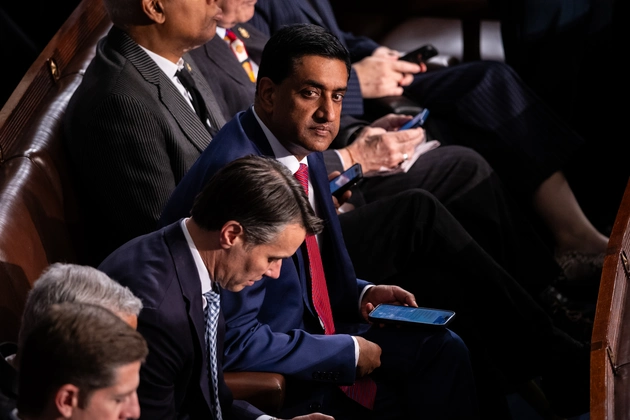
Members of Congress passed legislation this past June demanding that private-sector employers reach union contracts within 90 days of negotiations beginning — yet the same lawmakers have imposed no equivalent obligation on themselves, a contradiction thrown into sharp relief by the four-year bargaining saga that unfolded inside the office of Rep. Ro Khanna (D-California), one of the bill’s most vocal progressive supporters.
The Faster Labor Contracts Act, sponsored by Rep. Donald Norcross of New Jersey, cleared the House with 210 Democrats joined by 20 Republicans, and would require employers to begin contract negotiations within 10 days of a union’s certification. If no agreement emerges within 90 days of those talks starting, either party could request federal mediation through the Federal Mediation and Conciliation Service. Should mediation itself fail after 30 days, binding arbitration could impose a contract of up to two years’ duration — a significant intervention in the relationship between a business and its workforce. The bill has since stalled in the Senate.
The legislation draws its urgency from a well-documented problem: according to Bloomberg Law, newly unionized workers wait an average of 465 days to secure a first contract with their employer, and that figure counts only the units that eventually win a contract at all. Employer delay is a well-worn union-busting tactic, and the AFL-CIO along with more than 20 affiliated unions — including the IBEW, the Teamsters, the Machinists, and the United Steelworkers — have thrown their support behind the measure. Business groups have mounted predictable opposition.
What makes the bill’s stalled Senate trajectory particularly awkward is the timeline playing out on Capitol Hill itself. Khanna’s eight-person office staff voted to unionize in 2022, part of a modest wave of congressional organizing that briefly gained momentum under the Biden administration. The contract was not ratified until August 2026 — a full four years later — and its existence only became public knowledge when Politico reported on it in early October 2026. By the bill’s own standard, Khanna’s office would have been subject to binding arbitration roughly 46 months before a deal was actually reached.
Khanna himself framed the outcome as a milestone rather than an embarrassment, stating: “I’m proud of our office for signing the first long-term contract in the history of the U.S. Congress. I hope this can serve as a model for other offices in Congress.” The contract is, genuinely, a landmark — no congressional office had previously ratified a long-term collective bargaining agreement — but the timeline is a difficult one for a legislator championing urgency in the private sector to explain away.
The broader organizing momentum on Capitol Hill has largely dissipated since that initial 2022 surge. Fewer than a dozen congressional offices are currently unionized, and staffers who might otherwise pursue collective bargaining have been deterred by a combination of crushing workloads, adversarial or indifferent bosses, and the record-high staff turnover rates that have swept through Congress in recent years. Many aides have quietly concluded that the effort simply is not worth the disruption given how transient the work environment has become.
The structural asymmetry at the core of this story is not subtle. Congress has exempted itself from most major labor laws for much of its history — a legacy only partially addressed by the Congressional Accountability Act of 1995 — and the Faster Labor Contracts Act does nothing to change that. Lawmakers who invoke the language of worker dignity and prompt bargaining when addressing private employers operate under no legal compulsion to honor those same values within their own offices. The Khanna contract, celebrated as a model, took longer to negotiate than the legislation would allow any American business to take. That gap deserves more than a press release.