
A Microbial Discovery With Major Environmental Stakes
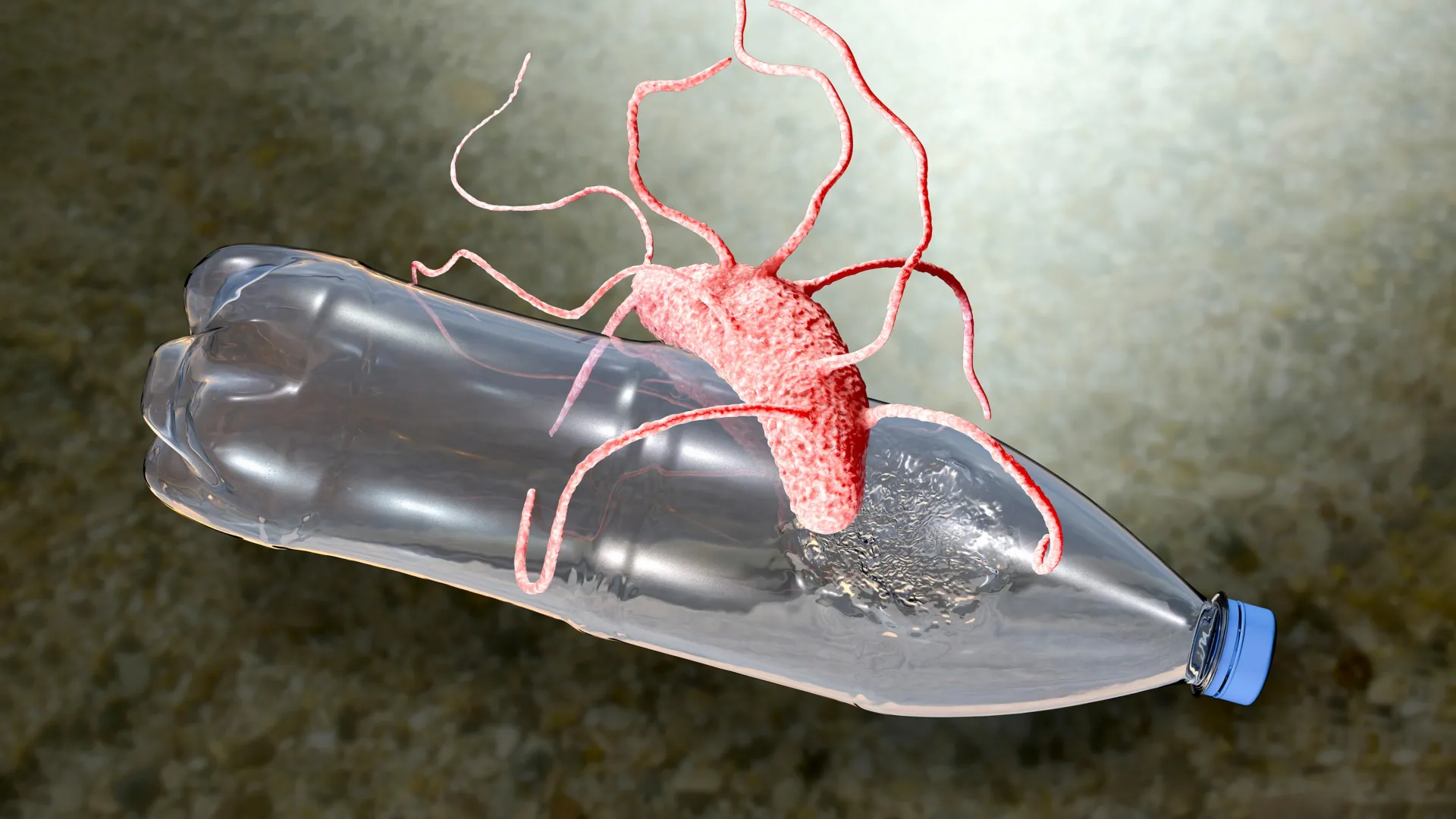
Scientists at the University of Konstanz have identified a remarkable bacterial enzyme capable of digesting certain biodegradable plastics — and it comes with a twist that nobody expected. The enzyme, nicknamed the “Pac-Man enzyme” for the unusually wide molecular opening at its active site, can break apart polyester chains the way a biological wrecking ball might dismantle a wall. It can also cleave penicillin, raising pointed questions about a possible link between plastic degradation and antibiotic resistance. The findings, published in The ISME Journal in October 2026, do not offer a silver bullet for the plastic pollution crisis — but they do offer something arguably more important: a scientifically grounded argument for redesigning what we make plastic from in the first place.
Plastic pollution is not a future problem. It is a present catastrophe. Hundreds of millions of tonnes of discarded plastic accumulate in oceans, soils, and freshwater systems every year, fragmenting not into harmless dust but into microplastics and nanoplastics that infiltrate food chains, drinking water, and human tissue. Conventional plastics — polyethylene, polypropylene, polystyrene — resist biological degradation almost entirely, because the synthetic polymer bonds they contain are chemically alien to most microbial metabolism. Bacteria can colonize plastic surfaces, forming what researchers call the “plastisphere,” but colonizing is not the same as consuming. Until now, the distinction has mattered enormously.
How the Research Began: Burying Plastic in Forest Soil
The investigation started with a deceptively simple experiment. University of Konstanz biologists Harry Lerner and David Schleheck wanted to understand not merely whether biodegradable plastics could decompose in natural conditions, but precisely which microorganisms were responsible and through what biological mechanisms they did it. Their focus fell on long-chain aliphatic polyesters, or LCAP — a class of biodegradable plastic developed by chemist Stefan Mecking and his research group, engineered to contain ester bonds that microbial enzymes can theoretically attack.
To observe real-world degradation, Lerner and Schleheck buried small films of LCAP bioplastic approximately ten centimeters deep in the upper humus layer of a forest at the university’s botanical garden. This was a deliberate choice. The humus layer is where nature already performs its most intensive decomposition work — breaking down cellulose, cutin, and other complex organic polymers through dense, active microbial communities. If any environment harbored microbes pre-adapted to attack polyester-like bonds, this was it. Parallel laboratory experiments used soil collected from the same forest, with powdered bioplastics mixed in and carbon dioxide emissions tracked over a full year as a proxy for microbial metabolic activity.
The Results: Biodegradable Plastics Gone, Polyethylene Untouched
The contrast in outcomes was stark and scientifically significant. All of the biodegradable plastic materials tested — including LCAP, PHBV, and PCL — broke down completely within approximately 250 to 330 days, roughly nine to eleven months. Cellulose, the natural benchmark, degraded faster, disappearing in around 80 days. Conventional high-density polyethylene (HDPE), meanwhile, showed virtually no decomposition whatsoever over the same period. The buried LCAP films confirmed these laboratory results when recovered from the forest: gone, where the conventional plastic would have remained essentially intact.
These numbers matter beyond the laboratory. They demonstrate concretely that the chemical architecture of a plastic material determines its environmental fate. Polyesters containing hydrolysable ester bonds give microbial enzymes a foothold. Polyethylene offers none. The implication for materials policy is direct: if regulatory frameworks required that plastics be designed with biochemical breaking points, the degradation timeline could shift from geological to biological. That is not a fantasy — it is what this experiment showed happening in real forest soil, in under a year.
Microscopic Holes and a Bacterial Feeding Strategy
When Lerner examined the recovered plastic films under electron microscopy, he found something unexpected on their surfaces. Scattered across the material were tiny holes, each roughly matching the dimensions of a single bacterial cell. The pattern was too regular to be coincidental. It suggested that bacteria were not merely sitting on the plastic’s surface — they were boring into it.
The hypothesis the researchers developed to explain this is elegant. Bacteria, they proposed, carry plastic-depolymerizing enzymes anchored directly to their outer cell membranes. Rather than secreting these enzymes freely into the surrounding environment — where they would diffuse away and lose efficiency — the bacteria keep them tethered to their surfaces, allowing them to digest the material immediately in front of them and physically embed themselves within the film. The microscopic cavities left behind are the biological equivalent of a bite mark. Depolymerases, the enzyme class involved, break large polymer molecules into smaller chemical units called monomers, which the bacteria can then absorb and metabolize as carbon and energy.
Identifying the Pac-Man Enzyme
To find the specific gene responsible, Lerner extracted and sequenced DNA from the entire microbial community living in the soil samples — a technique known as metagenomics — and tracked which genes became significantly more abundant as the LCAP bioplastic decomposed. One gene stood out clearly. It was strongly enriched in LCAP-containing soil and absent from the controls, pointing directly to its role in polyester degradation.
The gene encodes an esterase — an enzyme that cleaves ester bonds — but this particular esterase has an unusual structural feature. Its genetic instructions include both a secretion signal, which directs the enzyme outside the bacterial cell, and a lipid anchor, which tethers it to the cell membrane. The enzyme therefore sits on the bacterium’s outer surface, its active site exposed and ready to attack nearby polymer chains. That active site is exceptionally wide, giving the enzyme access to the bulky three-dimensional structure of plastic polymers. The researchers named it “Pac-Man” for this gaping molecular mouth. It is not merely a metaphor — the geometry of the active site is what makes the enzyme functionally capable of engaging with large synthetic molecules that would defeat a more conventionally shaped enzyme.
The Antibiotic Resistance Angle: Unexpected and Unsettling
The discovery grew more complex when researchers examined the Pac-Man enzyme’s molecular structure in detail. Despite functioning as an esterase, it bore significant structural similarities to beta-lactamases — a family of bacterial enzymes infamous for disabling antibiotics. Beta-lactamases work by cleaving the beta-lactam ring at the chemical core of antibiotics like penicillin, rendering them ineffective. They are a primary driver of antibiotic resistance globally, a public health emergency that already kills hundreds of thousands of people annually and that existing regulatory frameworks have been dangerously slow to address.
Laboratory tests confirmed that the Pac-Man enzyme can perform both functions. It breaks polyester chains into monomers and it cleaves penicillin. This dual activity is biologically striking because plastic degradation and antibiotic resistance have not previously been understood as connected processes. The researchers are appropriately cautious: demonstrating that an enzyme can chemically neutralize penicillin in a test tube does not prove it confers antibiotic resistance to living bacteria in a clinical or environmental context. But the structural overlap between plastic-digesting esterases and antibiotic-disabling beta-lactamases is a finding that demands further investigation, particularly as biodegradable plastics become more widely deployed in soil environments already under antibiotic pressure from agricultural runoff.
Microbial Adaptation and the Limits of Biological Solutions
The broader significance of the Pac-Man enzyme lies in what it reveals about microbial adaptation. Plastic pollution, in geological terms, is brand new. Humans have been releasing plastic into the environment in significant quantities for only about 50 to 75 years — an eyeblink of evolutionary time. As Schleheck explained, microorganisms would theoretically benefit from exploiting plastic as a carbon source, but most conventional plastics remain metabolically inaccessible. The plastisphere exists, but it has largely been a community of squatters rather than consumers.
The Pac-Man enzyme suggests the picture may be shifting — at least for polyester-based biodegradable materials. Bacteria appear to be developing or deploying enzymatic tools capable of attacking these specific polymer structures, potentially faster than researchers had assumed. That is genuinely encouraging news for the science of bioremediation. It is not, however, a reason to relax pressure on plastic producers or policymakers. The experiment was unambiguous: conventional polyethylene, the material that makes up the vast majority of plastic waste in oceans and landfills, remained essentially untouched. No Pac-Man enzyme is coming to eat the Great Pacific Garbage Patch.
What This Means for Policy and Materials Design
The real policy implication of this research is not that nature will clean up the mess humans have made — it is that humans need to stop making messes that nature cannot clean up. Schleheck put it plainly: tackling plastic pollution requires working with microbial capabilities rather than against them, and that means transitioning toward polymers that contain biochemical breaking points — hydrolysable ester bonds of the kind found in LCAP and other bioplastics — so that microbial communities can do what they evolved to do.
This is an argument for structural industrial policy, not consumer-level recycling theater. It means extending producer responsibility frameworks to require that new plastic materials demonstrate biodegradability under realistic environmental conditions — not just controlled industrial composting. It means funding research into next-generation bioplastics, supporting the kind of collaborative chemistry-biology work that produced this study. And it means treating the transition away from conventional plastics as a regulatory imperative, not a voluntary aspiration left to market forces that have spent decades producing exactly the wrong incentives. The Pac-Man enzyme is a promising biological tool. But tools do not build policy. People do.