
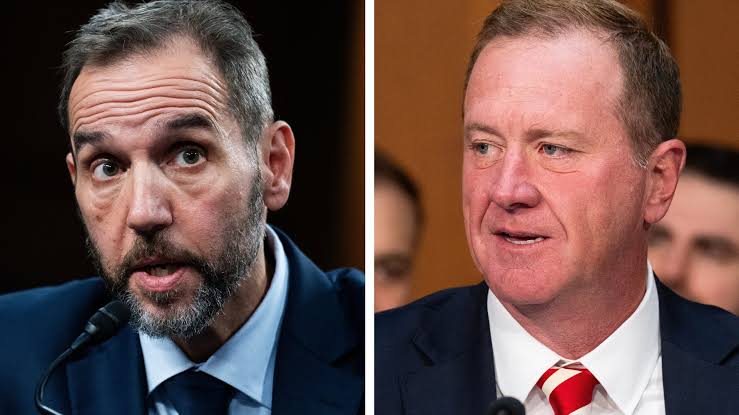
Republicans thought they were exposing a rogue prosecutor. They exposed their own president.
A trove of donor records released by Senate Judiciary Chairman Chuck Grassley (R-IA) to discredit special counsel Jack Smith has instead handed analysts a detailed paper trail of how Donald Trump pocketed money from loyal supporters while privately laughing at the election fraud claims he used to solicit it. The backfire is significant — and the evidence is in the checks themselves.
Legal analyst Marcy Wheeler, writing on her widely-read blog emptywheel, made the case Thursday that the 4,782 donor checks Grassley unveiled during Smith’s September 29 Senate testimony — followed Wednesday by a memo alleging Smith’s team obtained data on at least 639,000 Republican donors, voters and supporters — do far more damage to Trump than to the prosecutor Republicans were trying to vilify. Conservative media seized on both releases as proof Smith had weaponized the Justice Department against the GOP base. Wheeler methodically dismantled that framing.
What the Checks Actually Show
Much of the donor data Smith’s team gathered, Wheeler noted, is freely accessible through the Federal Election Commission or standard commercial vendors — hardly the stuff of a surveillance operation. What makes the checks genuinely revealing is their handwritten memo lines, small windows into the minds of ordinary Americans who believed, deeply and sincerely, that their democracy had been stolen.
One check, dated November 20, 2020, came from a donor in Greenville, North Carolina. The amount was $300. In the memo line: “Release the Kracken” — a reference to Trump attorney Sidney Powell, who had appeared the previous day alongside Rudy Giuliani at Republican National Committee headquarters to blame foreign communist money and Dominion Voting Systems software for Trump’s defeat.
That same day — November 20 — Trump got Powell on the phone from the Oval Office. As she repeated her claims, he muted the speaker, turned to the room, and laughed. “This does sound crazy, doesn’t it?” he asked, according to testimony former aide Hope Hicks gave the January 6 committee. Trump cashed the $300 check anyway.
The pattern held through December. On December 8, a donor in Burien, Washington, mailed $50 with the note “Go get em Rudy!” That same day, a senior campaign adviser — identified by Wheeler as Jason Miller — privately complained that the legal team’s claims were “conspiracy s— beamed down from the mothership.” That phrase later appeared in Trump’s federal indictment. The $50 was deposited regardless.
Wheeler also identified checks sent after Trump’s fake electors signed fraudulent certificates on December 14, with donors urging him to fight election corruption. Others were earmarked to help Republicans hold the Senate. Several arrived as postal cashier’s checks — a detail Wheeler read as evidence that some donors lacked even a bank account. Retirees, working-class supporters, people who could not easily afford what they gave.
“Trump, a billionaire, was cheating people who needed the money,” Wheeler wrote. That sentence carries weight precisely because the evidence for it came from a Republican senator trying to prove the opposite.
The Bigger Picture: Fraud, Not Overreach
This episode illustrates a dynamic that deserves direct naming. Grassley’s release was a political maneuver — an attempt to cast Smith’s investigation as a partisan witch hunt targeting ordinary conservatives. It relied on the assumption that the documents themselves would remain unread or unanalyzed by anyone outside friendly media. That assumption failed.
What Smith’s probe was actually tracking, the checks now confirm, was a fundraising operation built on claims Trump’s own inner circle knew to be false. Donors were not incidental to the scheme — they were the mechanism. The “Stop the Steal” apparatus converted manufactured outrage into cash, and the checks show exactly who paid: people writing “Release the Kracken” in the memo line, people sending $50 to Rudy, people who trusted that their president was telling them the truth.
He was not. And the Republican senator who tried to prove otherwise has now made that case in writing, with 4,782 pieces of evidence attached.