
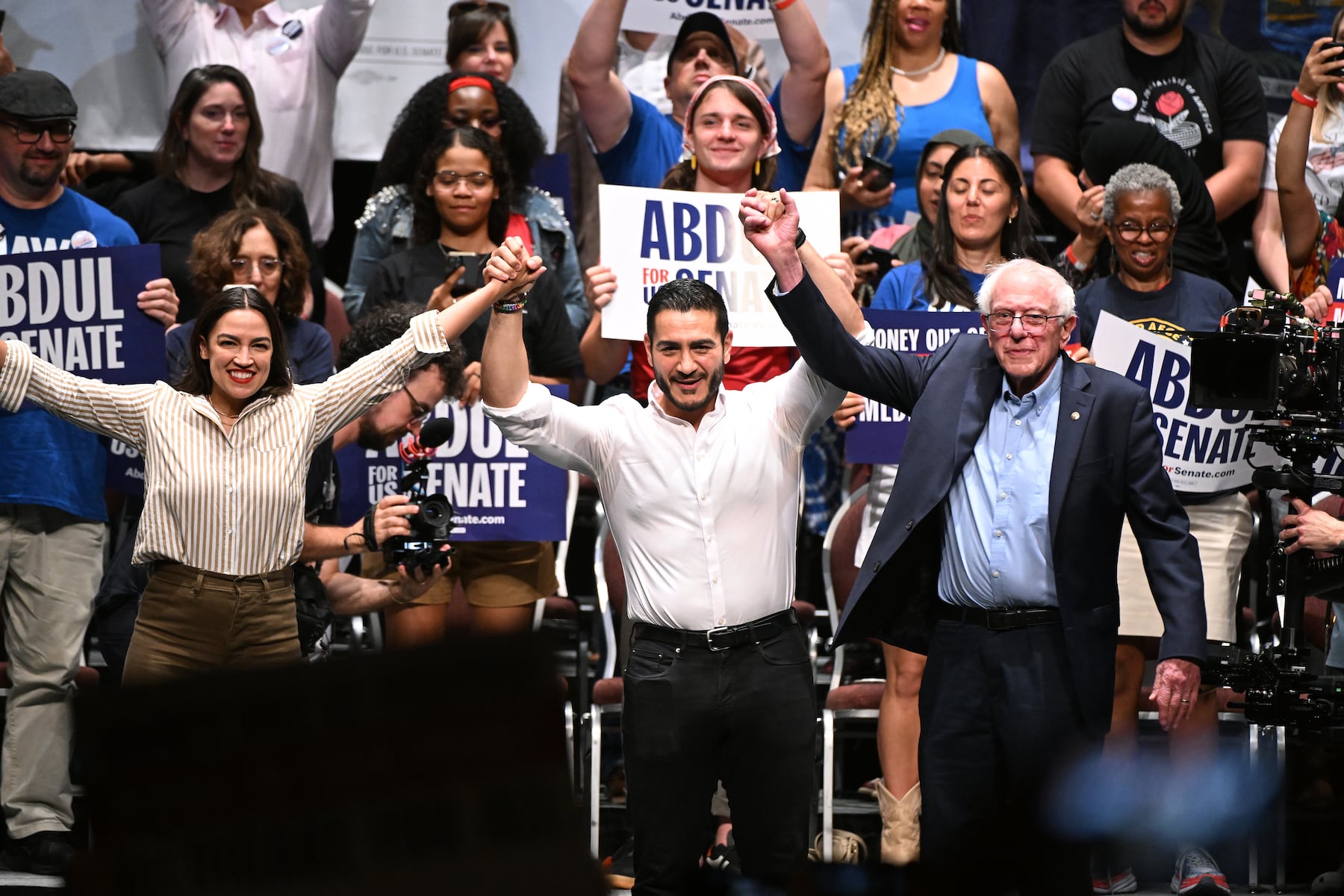
The Detroit Opera House filled with energy on Saturday, July 18, as Senator Bernie Sanders and Representative Alexandria Ocasio-Cortez took the stage alongside Abdul El-Sayed, the progressive candidate challenging the Democratic establishment in one of this cycle’s most consequential Senate primaries. The crowd was large, the message pointed: this race, Sanders declared, is “an election between Abdul and the billionaire class.”
The rally was the latest stop on Sanders and Ocasio-Cortez’s “The People vs. The Powerful” tour, and it brought together a striking lineup of progressive voices. UAW President Shawn Fain and Representative Rashida Tlaib joined the two national figures on stage, underscoring the coalition El-Sayed has assembled — organized labor, the congressional left, and grassroots activists who see the Michigan primary as a referendum on the direction of the Democratic Party itself.
El-Sayed, 41, is a physician and former public health director of Wayne County who ran a credible but unsuccessful campaign for governor in 2018. His platform is unambiguously progressive: he supports Medicare for All, has called for abolishing Immigration and Customs Enforcement, and has been an outspoken critic of unconditional U.S. military aid to Israel. On Saturday, he told the crowd that “it’s time to decide that we are no longer going to send unconditional foreign military aid to foreign governments.” Should he win the seat, El-Sayed would become the first Muslim senator in American history.
Standing against him is Representative Haley Stevens, who carries the backing of Senate Minority Leader Chuck Schumer and a broad swathe of establishment Democrats. The outside money flowing into her campaign has itself become a flashpoint. AIPAC has spent nearly $15 million in support of Stevens, a figure Sanders highlighted explicitly from the stage — a sign that the foreign policy divide within the Democratic Party is no longer being politely avoided but openly contested.
The polling reflects just how competitive the race has become. A Tavern Research survey conducted July 6–7 put Stevens at 42 percent and El-Sayed at 41 percent — a statistical tie. An earlier Detroit News/WDIV poll, taken after progressive state Senator Mallory McMorrow exited the race, showed Stevens with a seven-point advantage, suggesting McMorrow’s departure reshuffled the field in ways that have yet to fully settle. With the primary set for August 4, the trajectory remains genuinely uncertain.
The stakes extend well beyond Michigan. The seat, currently held by retiring Democratic Senator Gary Peters, is an open one — a rare and coveted prize in Senate politics. Republicans, who control the chamber with a 53–47 margin, have identified it as a top target. Former Republican Representative Mike Rogers runs unopposed on the GOP side, giving him months of runway while Democrats spend resources and political capital on an internal fight. Democrats hoping to reclaim the Senate majority cannot afford to lose this race regardless of who wins the primary.
What the Detroit rally made visible, though, is that for a significant and energized slice of the Democratic base, winning is not separable from what you stand for. Ocasio-Cortez, who endorsed El-Sayed on July 2, and Sanders, who has now stumped for him twice, are making an explicit argument: that a candidate willing to challenge AIPAC spending, defend universal healthcare, and question the terms of American foreign policy can win in a purple Midwestern state. The primary on August 4 will test whether that argument holds — and what kind of Democratic Party emerges to face the general election.