
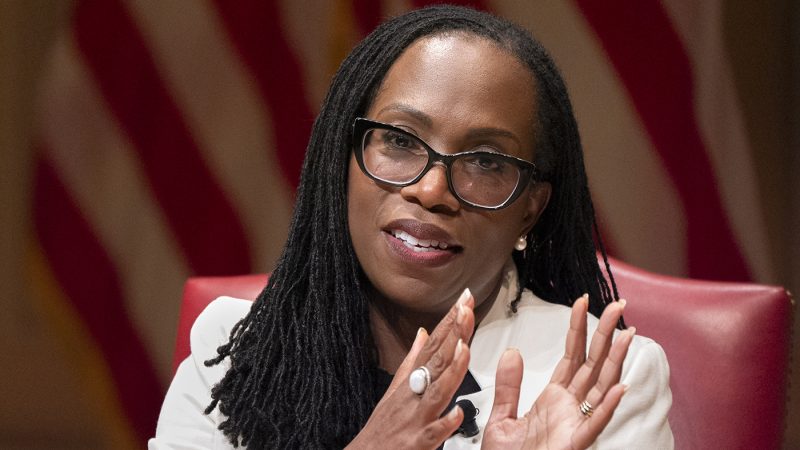
The Supreme Court’s two Black justices stared across an ideological chasm on Tuesday — and one of them blinked first in putting her disagreement on the record.
In a 20-page concurring opinion, Justice Ketanji Brown Jackson did not merely join the six-justice majority that struck down President Trump’s executive order restricting birthright citizenship. She went further, methodically dismantling the dissent written by Justice Clarence Thomas — her colleague, and the court’s longest-tenured and most conservative member — in terms that were pointed, historically grounded, and unmistakably personal in their intellectual stakes.
The majority ruling itself was decisive: the 14th Amendment guarantees citizenship to children born on U.S. soil, even those born to parents in the country without legal status. Chief Justice John Roberts joined justices Sonia Sotomayor, Elena Kagan, Amy Coney Barrett, and Jackson in that conclusion. Justice Brett Kavanaugh sided with the majority’s outcome but parted ways on the constitutional question of whether Trump’s order violated the 14th Amendment directly. Thomas, joined by justices Samuel Alito and Neil Gorsuch, dissented entirely.
A Colorblind Constitution, Selectively Applied
Thomas has spent decades championing what he calls a “colorblind” Constitution — the argument that the law must be race-neutral in its application, a position he deployed most prominently when the court’s conservative majority struck down race-conscious college admissions programs in 2023. Jackson challenged him sharply then, too. But Tuesday’s exchange cut deeper.
In his dissent, Thomas argued that the 14th Amendment’s Citizenship Clause applies only to those “domiciled” in the United States, and that children born here to parents who are temporary visitors or undocumented immigrants do not automatically qualify. To make that case, he reached back to the 1857 Dred Scott v. Sandford decision — the notorious ruling that held Black Americans could not be citizens — framing the 14th Amendment as a targeted remedy for that specific wrong. “Blacks were entitled to citizenship because they were Americans,” Thomas wrote. “They had no other homeland, owed no allegiance to any foreign power, and were subject to no other authority.” Foreign visitors, he continued, are “attached to their home country” and lack equivalent bonds to the United States.
Jackson’s response was swift and surgical. She noted the obvious tension: Thomas, the self-professed champion of colorblindness, was now arguing that the Citizenship Clause was a race-conscious, remedial measure — one designed specifically for freed slaves and those who “shared with them certain characteristics.” The implication of his reading, she wrote, is that children born in the United States to parents “not domiciled here” fall outside the amendment’s protection. That is a significant narrowing of a guarantee that has defined American citizenship for over 150 years.
The Promise the Court Has Repeatedly Broken
Jackson did not stop at calling out the logical inconsistency. She placed Thomas’s dissent within a longer, grimmer history. The 14th Amendment, she acknowledged, was enacted “with the one pervading purpose of securing equal citizenship for the freed slaves” — but the Supreme Court, she argued, has spent much of the time since then betraying that purpose. In the footnotes of her opinion, she listed 11 cases in which the court denied Americans the promise the amendment was meant to deliver, including the 2023 affirmative action ruling. “I suspect, though, that Justice Thomas and I disagree about when and how that promise has been denied by this Court,” she wrote. “My list is long (and sadly only getting longer).”
That footnote is not a throwaway. It is a quiet indictment — a running tally of constitutional failure that Jackson is keeping in plain sight, daring her colleagues to reckon with it. The 2023 affirmative action decision sits on that list. So, by implication, does Tuesday’s dissent, had it prevailed.
Jackson’s broader argument was that Thomas was treating a transformative constitutional moment with what she called a “myopic” and “narrow vision.” The 14th Amendment, she wrote, “caused a paradigm shift in the trajectory of our Nation.” To read it as a limited, race-specific fix for a single historical injustice — rather than as a sweeping guarantee of equal citizenship for all — is to miss the point entirely. She offered a teacher’s analogy to drive it home: “The teacher who scolds a student for bullying a classmate hopes the student learns the broader lesson of treating everyone with kindness, not just that one kid.”
What Was Actually at Stake
The case before the court was not abstract. Trump’s executive order, issued in the opening days of his return to the White House, sought to strip birthright citizenship from children born on U.S. soil unless at least one parent held citizenship or permanent legal status. Had it stood, the order would have upended a constitutional norm that has governed American life since 1868, creating a new class of stateless children born within the country’s borders — a consequence with profound human costs that the majority opinion, and Jackson’s concurrence, refused to ignore.
The ruling invalidates that order. But Thomas’s dissent, joined by two other justices, signals that a legal theory capable of gutting birthright citizenship has found a home on the court’s right flank. It did not command a majority on Tuesday. Whether it will in the future is a different question — and one that Jackson, with her carefully documented list of broken promises, seems determined to keep before the public record.
For now, children born in the United States retain the citizenship the 14th Amendment has always promised them. Jackson’s concurrence ensures that the intellectual fight over what that amendment means — and for whom — remains fully, visibly joined.