
The Federal Demand and What It Asks
The Trump administration’s Justice Department is pressing California county election officials to set aside mail-in ballots from more than 20,000 people it claims are likely noncitizens — and warning that officials who count those ballots could face criminal prosecution. The demand, issued just ten days before Election Day, has triggered a legal confrontation that is now before a federal appeals court.
Federal prosecutors sent letters on Friday to 57 of California’s 58 counties, giving them a 48-hour window to cross-reference a government list with federal agencies to confirm citizenship status. Los Angeles County had already received a similar letter the previous week. The letters were signed by Bill Essayli, first assistant U.S. attorney in Los Angeles.
According to a letter to San Bernardino County obtained by NBC News, the department wants counties to “segregate — not cancel” ballots from people on its list until citizenship can be confirmed. That county’s list alone included 1,133 names. The DOJ also asked counties to hand over sensitive voter data, including Social Security numbers and copies of voter registrations.
The Administration’s Justification — and Its Weaknesses
The Department of Homeland Security says it compared California’s voter registration files against federal immigration records and identified more than 20,000 people it describes as “likely” noncitizens. Under California law, every registered voter automatically receives a mail-in ballot, which the administration frames as a systemic vulnerability.
Homeland Security Secretary Markwayne Mullin amplified the alarm in a department release, asserting that “even one noncitizen vote cancels out the ballot of an American citizen.” Essayli sought to characterize the request as modest: “We’re not asking California to take any drastic steps other than to sequester the ballots from the suspected noncitizens,” he told Fox News.
But the administration’s track record on similar claims warrants serious scrutiny. In August, DHS told Nevada officials it had flagged roughly 15,900 possible noncitizen registrants. That figure later collapsed to just 185 confirmed cases through manual review — and Nevada’s own subsequent investigation found that all 185 were, in fact, U.S. citizens. DHS disputes that conclusion, but the episode illustrates how unreliable these federal data matches have proven in practice.
How Rare Is Noncitizen Voting, Really?
The empirical record does not support claims of widespread noncitizen voting. In 2024, Georgia Secretary of State Brad Raffensperger — a Republican — conducted a thorough audit of his state’s voter rolls and found just 20 noncitizens among approximately 8.2 million registered voters. That is a vanishingly small fraction, and it reflects the findings of virtually every rigorous review conducted in recent years.
Noncitizen voting does occur in isolated cases, but independent research and state-level investigations consistently find it to be exceedingly rare. The administration’s framing — that tens of thousands of ineligible ballots may be tainting California’s elections — is not supported by the available evidence and mirrors rhetoric that has repeatedly failed factual scrutiny.
Why California Is Refusing to Comply
Unverified Data, Legal Barriers, and Practical Impossibility
California officials have rejected the federal demand on multiple grounds. State lawyers argued in court filings that counties lack both the legal authority and the federal records necessary to independently verify citizenship — meaning the DOJ is asking officials to act on data they cannot themselves validate.
Secretary of State officials have also pointed out that the federal data has not been independently verified, and that acting on it risks disenfranchising eligible citizens whose names may have been incorrectly flagged. That concern is not abstract: data-matching errors of this kind have a documented history of disproportionately affecting naturalized citizens, immigrants, and voters of color.
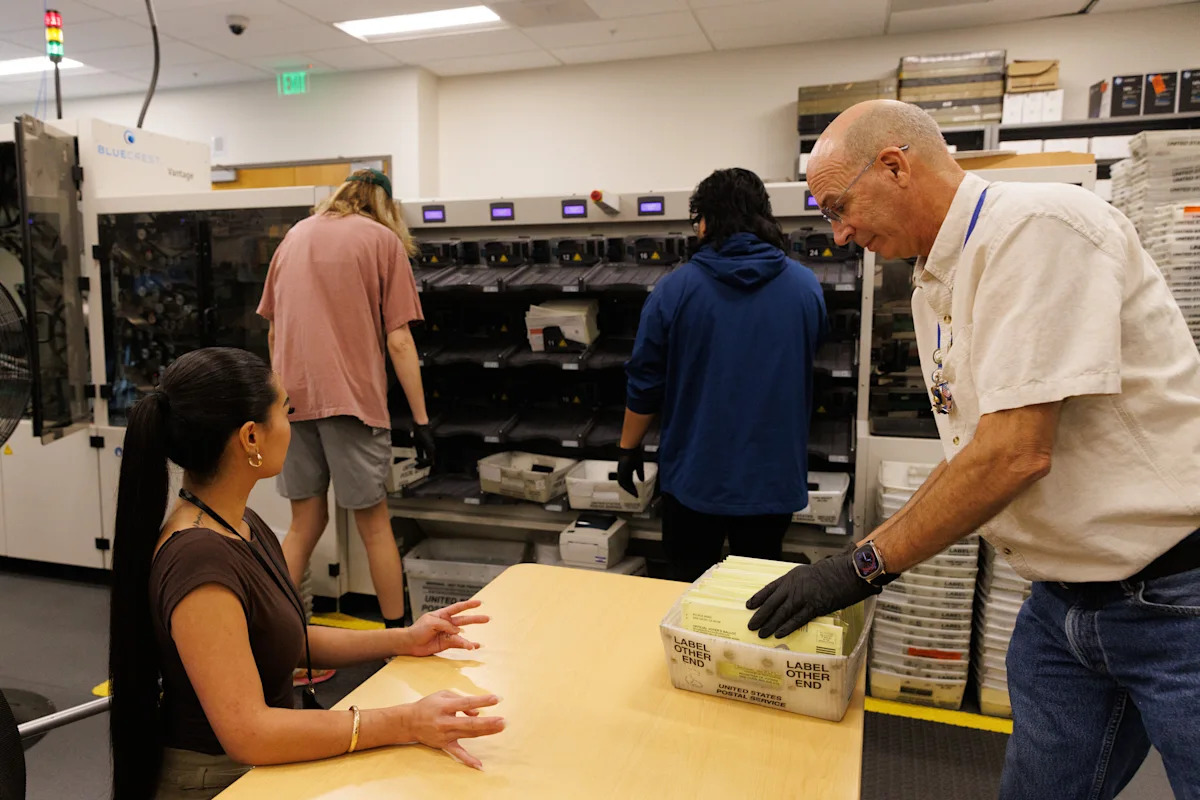
There is also a straightforward logistical obstacle. Once a mail-in ballot’s outer envelope is verified by signature, the ballot is separated from the envelope and counted alongside all others. Hundreds of thousands of ballots have already been processed this way, making retroactive segregation physically impossible for a significant portion of the list.
Intimidation at the Worst Possible Moment
Dean Logan, Los Angeles County’s top election official, described the letters as carrying “a posture of intimidation and threats” timed deliberately close to Election Day, CNN reported. Senator Alex Padilla, a California Democrat, stated flatly that the administration “has not provided any evidence for their claims of massive voter fraud.” The timing and tone of the federal intervention — criminal threats issued days before ballots are due — raises legitimate questions about whether the goal is election integrity or election disruption.
The Legal Battle Now Unfolding
The Justice Department sued both California and Los Angeles County on October 15 to block the disputed ballots from being counted. U.S. District Judge David Carter scheduled a hearing for Tuesday. Separately, the DOJ asked the 9th U.S. Circuit Court of Appeals to intervene sooner, and the appeals court ordered California to file a response by noon on Saturday.
No court has yet ordered California to set aside any ballots. Counties across the state are continuing to process returned mail-in ballots as normal while the legal fight plays out. The outcome of the appeals court proceedings will likely determine whether this confrontation escalates further before Election Day.
What California Voters Need to Know Right Now
For voters in California, nothing has changed in practical terms. Ballots are still being accepted and processed, and no judicial order has interrupted that process. Voters who want to confirm their ballot has been received and counted can use the California Secretary of State’s ballot tracking tool, available online. If you have already returned your ballot, it is almost certainly being processed normally.
The broader stakes, however, are significant. A federal administration using unverified data and criminal threats to pressure state election officials in the final days of an election cycle represents an extraordinary escalation — one that demands accountability regardless of which party benefits.