
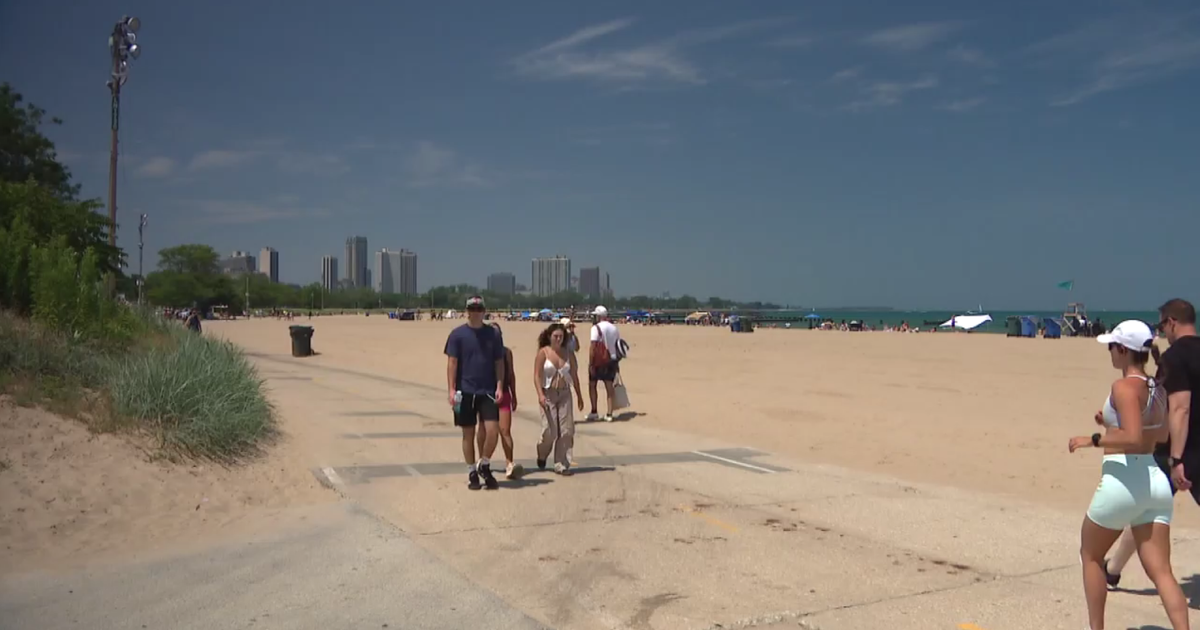
Chicago is two days into its first heatwave of the year. The city’s response looks almost identical to what it was a decade ago.
Health experts and community advocates say the Johnson administration’s current approach — centered on public messaging and daytime cooling centers — is dangerously insufficient for the residents most at risk: low-income Black and Latino communities on the South Side and West Side, elderly residents, and people experiencing homelessness. The core problem is simple and deadly. When the sun goes down, the centers close. The heat does not.
“One of the most dangerous things about heat waves is when the temperatures don’t go down at night,” said Dr. Sheetal Rao, assistant professor of medicine and public health at the University of Illinois Chicago. “Our body needs to have rest and a break from the heat.” This week, overnight temperatures are holding in the upper 70s and low 80s, with daytime heat indexes exceeding 100 degrees — offering almost no physiological recovery window for people without reliable air conditioning. “The stress and strain, the dehydration and the poor sleep can build up over several days,” Rao said. “Medically, people need a place to cool down 24 hours a day during this level of extreme heat.”
Why are some neighborhoods so much more exposed?
The geography of heat risk in Chicago is not random. It tracks almost perfectly onto the geography of disinvestment. Poorer neighborhoods — disproportionately Black and Latino — have fewer trees, less shade, and vast stretches of concrete and asphalt that absorb heat during the day and radiate it back through the night. Many of these communities sit farther from Lake Michigan, losing access to the cooling effect that benefits wealthier North Side neighborhoods. A 2023 urban heat mapping initiative, in which the advocacy group People’s Response Network participated, found a staggering 20-degree temperature difference between Rogers Park on the North Side and Archer Heights on the Southwest Side on a single summer day.
Northwestern University researchers have spent three years analyzing tens of thousands of data points to identify who is most likely to get sick or die from extreme heat. Last year, they delivered their findings to City Hall alongside 30 concrete recommendations, including expanded cooling centers. It remains unclear how many of those recommendations the city has acted on. An updated presentation is expected in the coming weeks.
Former Chicago Department of Public Health Assistant Commissioner Dr. Howard Ehrman is direct about the failure. “The city’s response has changed little over past administrations despite decades of research showing the dangers of prolonged heat exposure,” he told the Sun-Times. Outreach, he said, must focus specifically on predominantly Black and Latino neighborhoods, where residents carry higher rates of chronic health conditions that amplify heat-related risk.
Lonette Sims, chairperson of the People’s Response Network, is pushing City Hall to act now rather than after the next preventable death. She wants mobile outreach teams and cooling buses deployed directly to homeless encampments and low-income neighborhoods — a model other cities have already adopted. She is also calling for temporary utility shutoff moratoriums during heat emergencies, so residents are not forced to choose between paying their electric bill and running a fan. “We feel a need to keep pushing for the city of Chicago to be more preventative,” Sims said.
Registered nurse Monica Dillon, who spent years doing homeless outreach in Chicago, describes what the current plan looks like on the ground. “The city’s plan is to just send everybody to buildings that are already open from 9 to 5,” she said. “These places are not prepared to accept people en masse anyway.” Dillon points to Cook County’s 24-hour courthouse cooling and warming centers — including the Skokie courthouse — as a model worth replicating. Those facilities allow people to stay indoors around the clock, provide water and snacks, and even accommodate pets. “Ideally, each community really needs to have their own hub, 24/7, available to accommodate everybody in that community,” she said.
Mayor Brandon Johnson’s administration did not respond to a request for comment. That silence is itself a statement. The research exists. The recommendations have been delivered. The communities most at risk are already known. What is missing is not information — it is urgency.