
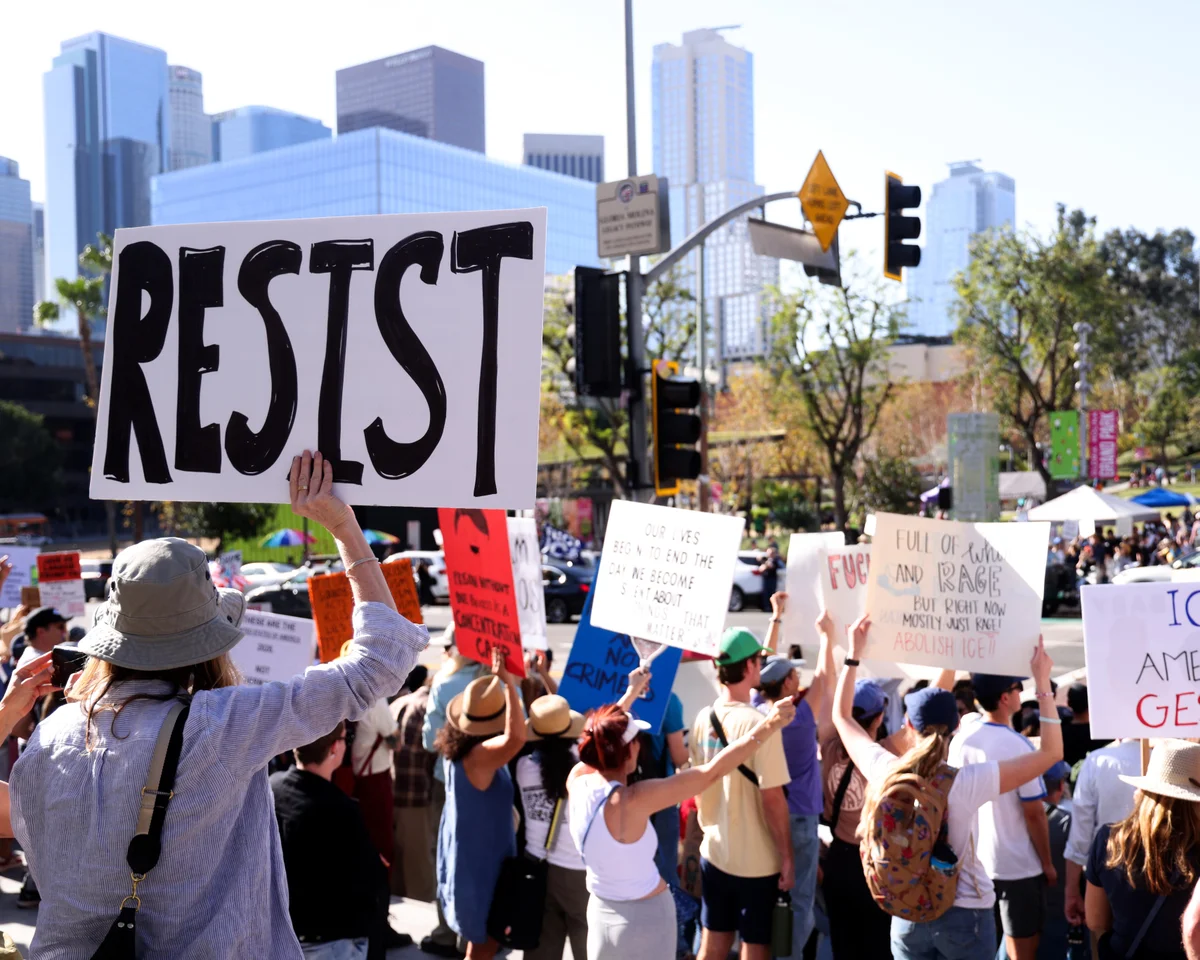
On a Saturday afternoon in Long Beach, California, Ricardo Gonzalez — a former city employee and United States citizen — ended up face down in a gutter, handcuffed, with Immigration and Customs Enforcement officers kneeling on his back. His arm was broken. He had been tased twice. Video of the encounter circulated widely, and what it showed was not an isolated mishap but the increasingly familiar face of federal immigration enforcement under the Trump administration: unmarked vehicles, disproportionate force, and communities left to document the aftermath on their phones.
According to his daughter Leslie’s online fundraiser for his medical expenses, Gonzalez was knocked off his e-bike by an unmarked ICE vehicle before agents tased him and pinned him to the ground. Long Beach Mayor Rex Richardson confirmed to CNN that Gonzalez had called emergency responders for help at some point during the encounter. When police arrived, they found him injured on a curb, still in handcuffs. “He was detained. He was on a curb. He was injured,” Richardson said, with a plainness that itself speaks volumes.
The Long Beach Police Department (LBPD) was unequivocal that it played no role in immigration enforcement and made no arrests. Its officers transported the handcuffed and bleeding Gonzalez to a nearby fire station, where they removed his restraints and paramedics took him to hospital. The LBPD statement also noted that ICE agents who followed officers into a secure parking lot were told to leave — and that if they wished to file a vandalism report, they could call the city’s communications center. The quiet bureaucratic rebuke barely conceals the tension between local law enforcement trying to maintain community trust and federal agents operating with an entirely different mandate.
The Department of Homeland Security, which oversees ICE, has offered no public explanation for why Gonzalez was detained in the first place. That silence is itself a pattern. The agency habitually frames its agents’ actions as self-defense or public safety measures, a rhetorical posture that grows harder to sustain as footage accumulates of handcuffed civilians bleeding in gutters. The Guardian contacted ICE for comment; no response was forthcoming.
Congressman Robert Garcia, a Democrat who represents Long Beach, did not mince words. “ICE agents brutally attacked and broke the arm of a North Long Beach resident and US citizen,” he wrote on X, calling the videos “horrific” and expressing pride in the neighbors who documented the encounter and stood up for the family. Garcia called for the abolition of ICE — a position that distinguishes a genuinely progressive response from a merely liberal one, which might stop at demanding accountability while leaving the institutional architecture intact. “Donald Trump and his inhumane and illegal deportation machine must be stopped,” Garcia added. “Long Beach stands with our community and our immigrant families.”
What makes the Gonzalez case particularly alarming is that it does not stand alone. Just weeks earlier, on October 10th, an ICE agent driving an unmarked SUV in the Houston area ran over a man and broke his leg in three places. Video of that encounter appeared to show the vehicle deliberately swerving into him in a parking lot. Harris County District Attorney Sean Teare announced he was considering felony assault charges against the officer involved — a rare instance of state-level accountability being brought to bear on federal enforcement conduct.
That Houston incident carried its own grotesque dimension. At a Friday news conference, the Houston-based advocacy group FIEL alleged that ICE had crashed into the man while searching for someone who had been dead for years. FIEL said it had handed Teare a death certificate for the individual ICE was apparently seeking. ICE did not respond to the Associated Press’s questions on the matter. The agency’s silence, repeated across both incidents, is not neutral — it is a choice, and it forecloses the transparency that democratic accountability requires.
These are not rogue agents acting against policy. They are agents acting within a system that has been deliberately expanded, emboldened, and shielded from scrutiny by an administration that treats immigration enforcement as a performance of dominance rather than a function of law. The communities absorbing the consequences — in Long Beach, in Houston, and beyond — are disproportionately Latino, disproportionately working-class, and now living with the knowledge that an unmarked federal vehicle can knock a neighbor off a bicycle and leave him bleeding in a gutter with no immediate public explanation owed to anyone. Ricardo Gonzalez is a US citizen. That fact should not be the most important thing about this story — but in a political climate where citizenship is being weaponized as a sorting mechanism, it is worth saying clearly, and loudly, that it did not protect him.