
A measles exposure warning issued by the Alabama Department of Public Health this week is not an isolated scare — it is a local symptom of a national public health failure. The central fact is this: measles, a disease that was declared eliminated in the United States in 2000, has now infected more than 4,000 Americans this year alone. That resurgence did not happen by accident. It happened because vaccination rates have slipped, and because public health infrastructure has been systematically underfunded and, in some quarters, politically undermined.
The immediate situation in Alabama is straightforward. An international traveler who tested positive for measles visited two businesses in the Bailey Cove area of Huntsville while infectious. The Alabama Department of Public Health, acting on a report from a private laboratory, has identified the Subway restaurant at 7900 Bailey Cove Road as a potential exposure site on October 4, 5, and 6, between 11:30 a.m. and 3 p.m. each day. The Publix grocery store at 12796 Bailey Cove Road Southeast was also identified as a potential exposure site on October 4, between 1 p.m. and 3 p.m. Anyone present at either location during those windows should check their vaccination status immediately and monitor for symptoms.
Measles is among the most contagious pathogens known to medicine. Roughly 90 percent of unvaccinated people exposed to the virus will contract it — a transmission rate that makes the disease an unforgiving test of any community’s immunization coverage. The virus travels through the air when an infected person coughs or sneezes, and critically, an infected individual can spread it for several days before symptoms even appear. Those symptoms — high fever exceeding 104 degrees, cough, runny nose, red or watery eyes, and a characteristic rash — typically emerge seven to fourteen days after exposure, meaning the window for unknowing transmission is wide.
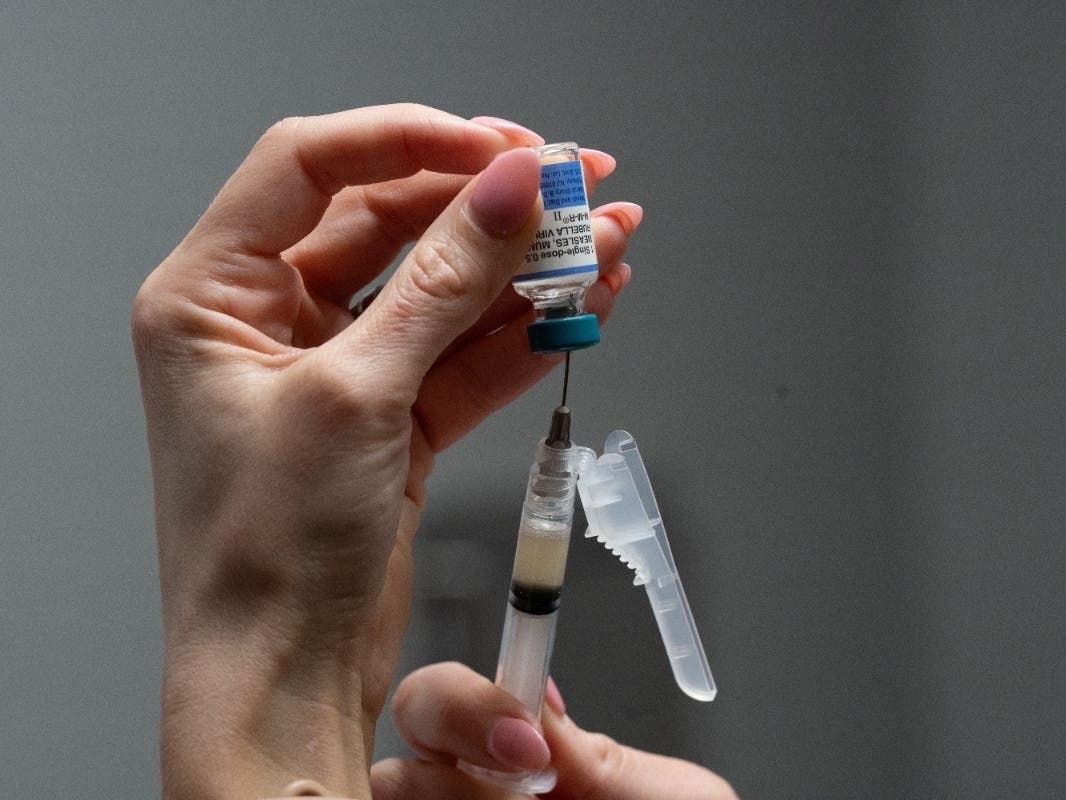
The stakes are not abstract. Measles causes serious complications, particularly in children under five, including pneumonia, brain swelling, and death. These are not rare worst-case scenarios; they are documented, predictable outcomes when vaccination coverage falls below the threshold needed for community protection. The CDC recommends two doses of the MMR vaccine — measles, mumps, and rubella — for children, a protocol that is highly effective and has been refined over decades of rigorous public health science. For international travelers, including infants between six and eleven months, early vaccination before departure is strongly advised.
What makes the Huntsville case more than a local news item is the national context it inhabits. More than 4,000 confirmed measles cases across the United States in a single year represents a dramatic reversal of one of modern public health’s genuine achievements. That reversal tracks directly with the spread of vaccine hesitancy, much of it amplified by bad-faith actors and tolerated — sometimes encouraged — by political figures who treat settled science as a matter of opinion. The consequences fall hardest on the most vulnerable: infants too young to be vaccinated, immunocompromised individuals who cannot be vaccinated, and communities where access to healthcare remains structurally limited.
The state’s public health response here is appropriate — rapid disclosure, clear exposure windows, actionable guidance. But disclosure alone cannot substitute for the sustained public investment in vaccination infrastructure and health education that prevents these situations from arising. Anyone uncertain about their vaccination status should contact a healthcare provider without delay. The MMR vaccine works. The evidence is not in dispute. The question is whether public institutions retain the political will and the resources to ensure it reaches everyone who needs it.