
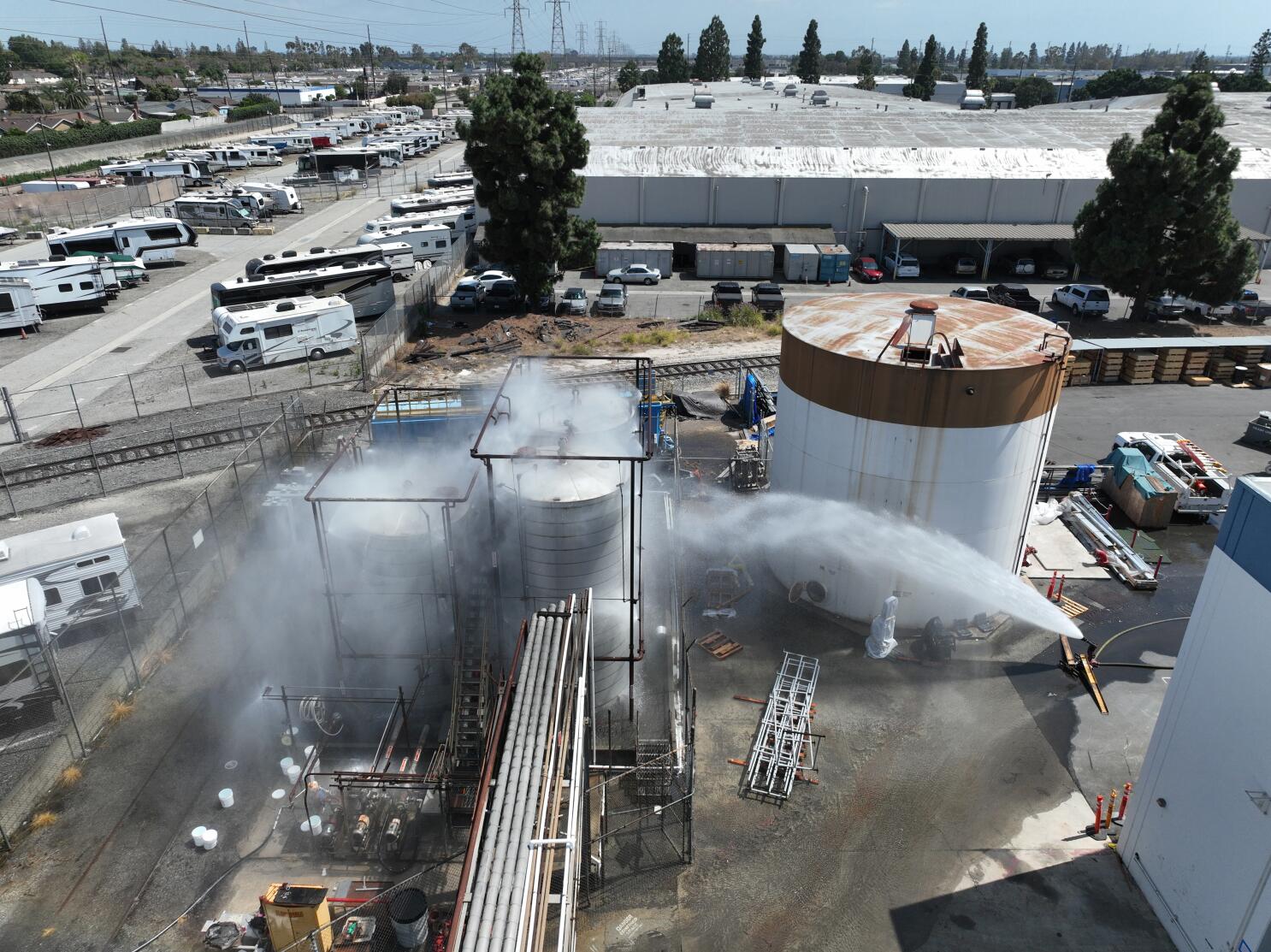
Tank Temperature Rising, Explosion Risk Grows at Garden Grove Aerospace Facility
A critically unstable tank holding roughly 7,000 gallons of highly toxic methyl methacrylate (MMA) at a Garden Grove aerospace facility is growing more dangerous by the hour, officials confirmed Saturday — with the tank’s internal temperature climbing approximately one degree per hour and no clear resolution in sight.
The facility, operated by GKN Aerospace, sits adjacent to an elementary school and a residential neighborhood. Authorities have imposed an evacuation zone stretching one to three miles from the site, displacing an estimated 40,000 residents across portions of Garden Grove, Anaheim, Buena Park, Cypress, Stanton, and Westminster.
By Saturday morning, the tank’s internal temperature had reached 90 degrees Fahrenheit, up sharply from 77 degrees the previous day. The temperature gauge on the tank maxes out at 100 degrees — and officials have not publicly stated the precise threshold at which they would consider an explosion imminent.
A Critical Miscalculation Set Back the Response
The crisis deepened overnight after officials discovered they had been misreading the data. Drone thermometers deployed Friday had indicated the tank was at 61 degrees — leading crews to believe their water-cooling efforts were working. That reading, it turned out, reflected only the outside surface temperature of the tank, not the interior.
Workers who returned to the site overnight were able to manually read the internal gauge — which is obscured by cooling water sprays and cannot be monitored remotely — and found the actual interior temperature was far higher than believed.
The error cost valuable time and forced officials to reassess the situation from a significantly worse starting point.
Why the Tank Is So Difficult to Neutralize
The standard approach to neutralizing an unstable MMA tank would be to pump an inhibiting agent directly into it, halting the chemical reaction. That option is no longer available.
MMA monomers — individual molecules — are reacting with one another inside the tank, forming polymers and solidifying. That solidification process has clogged the tank’s inlet valve, blocking any attempt to inject a neutralizing agent. There is also no way to drain the tank.
“The reaction is releasing heat. That’s going to initiate more reaction to happen, so it might even cascade,” said Elias Picazo, assistant professor of chemistry at USC, describing the risk of a thermal runaway reaction — a self-reinforcing cycle of heat and chemical activity that can end in an explosion.
The “Third Option”: Controlled Cooling as a Last Resort
As of Saturday, the primary strategy is to keep spraying water on the tank to slow — though not stop — the temperature increase. Officials and outside experts are now pinning their hopes on what Orange County Fire Authority Division Chief Craig Covey described as a potential “third option.”
Covey had previously been told by chemists that only two outcomes were possible: explosion or massive chemical leak. But ongoing consultation with experts has raised the possibility that sustained cooling could allow the MMA to cure slowly and solidify in a controlled manner, reducing pressure buildup inside the tank enough to avoid a rupture.
“Like an ice cube that freezes from the outside in — this stuff cures from the outside in. While it’s doing that process, it’s building pressure,” Covey said. “We’re hoping that that space can absorb a slower cure rate and not over-pressure and blow up.”
Picazo supported that analysis. “One of the best-case scenarios is to let the monomers react, but you do it in a controlled way,” he said. “If it’s slow enough, you can form solid within the tank and cause the reactive monomers to stay apart from one another — and if they don’t come into contact, they cannot react.”
If that scenario plays out, officials could then explore additional options to neutralize whatever unreacted MMA remains.
A Second Tank Adds to the Stakes
Adjacent to the failing tank is a second tank containing 15,000 gallons of chemicals. Though not currently at risk of failure, officials moved overnight to inject a neutralizing agent into it — a precautionary measure to ensure that if the primary tank explodes, it does not trigger a far larger secondary blast.
Covey acknowledged that the operation put first responders and chemists “in harm’s way.”
Officials Remain Cautiously Optimistic
Despite the deteriorating conditions, fire officials say they have not given up on preventing the worst outcome.
“We’re optimistic,” Covey said Saturday. “We’re bringing people in from all over the country, talking to people all over the place, trying to come up with additional options. Letting this thing just fail and blow up is unacceptable to us.”
The crisis, now in its third day, underscores the risks posed by industrial chemical storage in densely populated residential areas — and the limits of emergency response when basic monitoring infrastructure, like a remotely readable internal temperature gauge, is absent.
Staff writers Hailey Branson-Potts, Hannah Fry, and Eric Licas of the Los Angeles Times contributed reporting to the original version of this article.