
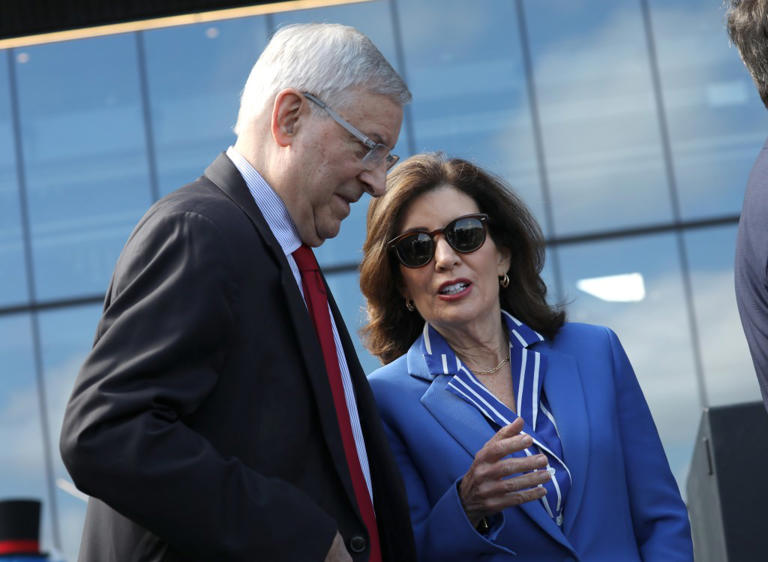
The central question raised by this week’s New York campaign finance filings is not whether money flows toward power — it does, reliably and predictably — but whether that flow has become so normalized that it no longer registers as a problem. The answer, in the case of Buffalo Bills owners Terry and Kim Pegula and Governor Kathy Hochul, is that it should.
The filings, submitted to the state Board of Elections, reveal that Terry Pegula wrote two checks in January: $138,600 to the Democratic State Committee and $18,000 directly to Hochul’s campaign account. His wife and co-owner Kim Pegula contributed an additional $18,000 to the governor’s campaign. Together, the Pegulas directed nearly $175,000 toward Hochul’s re-election effort. These are, the filings confirm, the first political contributions the couple has made to Hochul since she shepherded a $600 million state appropriation in 2022 to subsidize the construction of a new Bills stadium — one of the largest public stadium subsidies in American history.
The timing alone demands scrutiny. Hochul attended the stadium’s ribbon-cutting ceremony last month and declared, with evident pride, “I had to deliver this stadium for Western New York.” Terry Pegula, standing beside her, was equally candid: “I don’t know if we’d be here today without Kathy’s support.” Both statements are probably true. That is precisely the problem.
Public stadium financing has long been one of the most thoroughly debunked forms of economic development spending. Study after peer-reviewed study has found that taxpayer-funded stadiums generate little of the promised economic activity, disproportionately enrich already-wealthy team owners, and divert public capital from genuinely pressing needs — housing, transit, healthcare infrastructure — toward facilities that serve a private entertainment business. New York committed $600 million of public money to benefit a franchise owned by billionaires. Those billionaires are now among the largest individual contributors to the governor’s re-election campaign.
Hochul’s spokesperson Kara Cumoletti offered the standard reassurance: campaign donations have no influence on the governor’s decisions, and “the only thing that drives the governor’s decisions is what’s best for New Yorkers.” This is the answer every political operation gives, and it is almost never the whole truth. Blair Horner, a senior adviser at the New York Public Interest Research Group and a veteran government watchdog, was more direct: “Money follows power. And those with business before the government are willing to write the biggest checks they can in the hopes of getting favors returned.”
The broader donor list reinforces the pattern. Among those who gave the maximum allowable contribution to the Democratic State Committee — a committee with a significantly higher ceiling than the governor’s personal account — are real estate developers, hedge fund principals, a landlord trade group called the New York Apartment Association, and hotel and construction industry unions. The mix is telling: it reflects not a grassroots coalition but a cross-section of industries with active regulatory and legislative interests before Albany. Melinda French Gates also appears on the list, though her interests in New York state government are less immediately apparent.
None of this makes Hochul corrupt in any legal sense, and it is worth being clear about that distinction. She enters the final stretch of the campaign with a commanding financial advantage — $21 million on hand compared to Republican challenger Bruce Blakeman’s $4.6 million — and a double-digit polling lead. Blakeman, the Nassau County Executive, has raised $7.4 million since declaring his candidacy, a respectable sum but one that reflects the structural disadvantage of challenging a sitting governor in a heavily Democratic state.
What the Pegula donations illustrate is something more corrosive than outright corruption: the routine, legal, and largely unremarked exchange of political gratitude for public generosity. Progressive governance, at its most coherent, insists that public funds serve public purposes — that state appropriations respond to collective need rather than the preferences of wealthy stakeholders. A $600 million subsidy to a billionaire-owned NFL franchise, followed by six-figure campaign contributions from those same billionaires, does not meet that standard. The fact that it is entirely legal does not make it defensible. It makes it a structural problem, and one that Hochul, for all her genuine accomplishments, has not reckoned with honestly.