
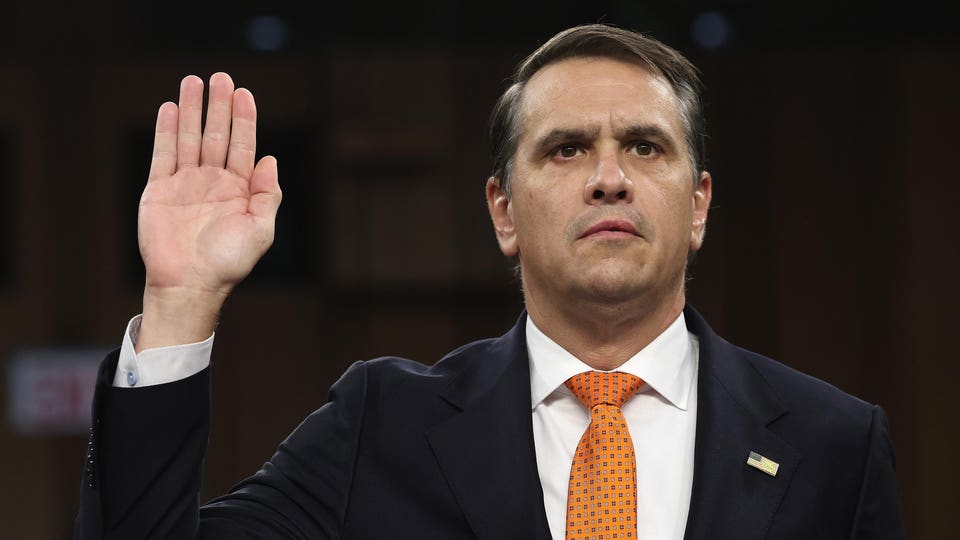
Todd Blanche was sworn in as attorney general of the United States on Monday, completing a contentious 50-49 Senate confirmation that exposed a fundamental tension at the heart of American democratic governance: can a man who spent years as Donald Trump’s personal criminal defense attorney credibly lead the institution charged with enforcing the law impartially? The evidence so far suggests the answer is no — and the coming months will either prove that suspicion right or offer a rare, unexpected vindication.
This is not a matter of partisan preference. It is a structural problem. Blanche arrives at the Justice Department carrying nearly $9.8 million in legal fees paid to his firm by Trump’s Save America PAC between April 2023 and February 2025 — including a $543,711 payment made shortly after Trump’s inauguration. He was confirmed with the thinnest possible majority. His swearing-in took place behind closed doors at the White House, away from the press, with only a video released by press secretary Karoline Leavitt to mark the occasion. These are not the hallmarks of an independent law enforcement officer. They are the hallmarks of a political appointment.
Senator Dick Durbin of Illinois put it plainly at a Senate Judiciary Committee hearing: Blanche “continues to operate as the president’s personal lawyer.” What follows is an examination of why that charge carries real weight, and what the specific pressure points ahead will reveal about whether the rule of law still functions as a meaningful constraint on executive power.
The Structural Conflict That Blanche Cannot Escape
Blanche’s own testimony during his confirmation hearing was, in its way, more candid than his defenders would have liked. When pressed on DOJ independence — a norm built painstakingly over decades precisely to prevent the weaponization of federal prosecutorial power — Blanche did not defend that independence. He acknowledged that Trump “can fire me whenever he wants” and that he would be “a member of the Cabinet.” He added that he was unafraid to push back on the president, insisting that “counsel does not mean I’m a yes man.” But the very framing of that assurance — that he would offer counsel, not exercise independent legal judgment — reveals the problem. An attorney general who thinks of himself as the president’s counselor is not the same as one who thinks of himself as the people’s chief law enforcement officer.
The slip during his testimony — when Senator John Kennedy of Louisiana asked if he was friends with Trump and Blanche first responded, “I am his lawyer,” before catching himself — was more revealing than any prepared statement. The correction came fast. The instinct came faster.
What makes this consequential rather than merely embarrassing is the specific set of decisions now landing on Blanche’s desk. They are not abstract questions of institutional philosophy. They are live cases, live investigations, and live political fights — each one a concrete test of whether the Justice Department under Blanche will serve the Constitution or the man who appointed him.
The Epstein Files: Transparency, Victims, and a Thursday Deadline
The most immediate test arrives this Thursday, when Blanche is scheduled to appear before Judge Emmet G. Sullivan for a hearing over the release of Epstein-related documents. The DOJ’s handling of those files has already drawn sharp criticism: victim identities were not properly redacted in materials that were released, Epstein’s victims have accused Blanche of failing to engage meaningfully with their concerns, and Judge Sullivan has noted a series of procedural failures — including Blanche’s failure to provide documentation justifying redactions, his failure to explain why handwritten notes cannot be redacted rather than withheld entirely, and his non-compliance with the Epstein Files Transparency Act’s requirement that the DOJ submit a log justifying every single redaction.
The complicating factor is that some of the withheld documents contain unsubstantiated allegations directly involving Trump. The DOJ has fought their release. Whether Blanche continues that fight with the same ferocity — or shows any willingness to comply with the court’s transparency expectations — will be the first real signal of how he intends to manage the inevitable collision between legal obligation and presidential interest.
The IRS Settlement: A $1.8 Billion Fund That Isn’t Dead
The issue that most nearly derailed Blanche’s confirmation was his signing and defense of a settlement between Trump and the IRS that included a $1.776 billion “anti-weaponization fund” — designed to compensate political allies, including January 6th rioters — and a broad immunity clause shielding Trump and his affiliates from government legal action. Under pressure from Republican senators John Cornyn and Thom Tillis, Blanche issued orders declaring the fund “dead” and narrowing the immunity deal’s scope. But those orders are not legally binding under the settlement’s own terms, which require written agreement from all parties to any modification. That agreement never happened.
Democrats have been explicit about the risk: Blanche could simply issue a new order and revive the fund after being sworn in. Trump himself confirmed he did not personally sign the order killing it — a signal, noted by multiple observers, that the door remains open. The question is not whether the fund could come back. It is whether Blanche will allow it to, and whether payouts to political allies will proceed through this mechanism or a successor arrangement.
Prosecutorial Power as a Political Weapon
The pattern of DOJ action against Trump’s political opponents is, at this point, too consistent to dismiss as coincidence. The department has brought charges or launched investigations against former FBI Director James Comey, New York Attorney General Letitia James, former national security adviser John Bolton, Senator Adam Schiff, former CIA Director John Brennan, Minnesota Governor Tim Walz, and Minneapolis Mayor Jacob Frey. Trump fired his previous attorney general, Pam Bondi, after publicly expressing frustration that she had not gone far enough in punishing his critics. Blanche now inherits that pressure — and, by all indications, a president who will apply it more directly.
Legal experts have repeatedly criticized the charges brought in several of these cases as resting on weak legal foundations. The prosecution of Comey continues even after initial charges were dismissed. The message being sent — to political opponents, to state officials, to anyone who might challenge the administration — is unmistakable, and it is Blanche’s signature that will now appear on whatever comes next.
The inverse dynamic is equally troubling. SpaceX, led by Elon Musk during his period as a senior Trump adviser, had a discrimination lawsuit dropped by the DOJ in February 2025. Criminal probes against Boeing and Abbott Laboratories were closed after both companies made substantial donations to Trump’s inaugural fund. The government has not alleged any connection between those donations and those decisions. It has not needed to. The pattern speaks for itself, and Blanche will now be the one managing it.
Elections, Construction Projects, and the Accumulation of Power
Looking further ahead, Blanche’s DOJ will be responsible for defending Trump’s executive orders on voting ahead of the November midterms — orders built on the president’s long-standing and evidence-free claim that widespread electoral fraud exists. Those orders include restrictions on mail-in voting, demands for state voter rolls, and directives to the U.S. Postal Service to withhold absentee ballots from voters not appearing on state-approved lists. Many are already in litigation. Blanche’s department will argue for them in court, and may be called upon to litigate the results if Trump decides to challenge outcomes he dislikes.
Even the seemingly minor matters carry weight. Blanche will oversee litigation over the construction of a new White House ballroom — halted by a federal appeals court last week, with Trump calling the ruling a “National Security threat” — and continued disputes over the Kennedy Center, where a tarp still covers the venue’s sign after a court ordered Trump’s name removed. These are not grave constitutional crises on their own. But they illustrate the degree to which the Justice Department is now being asked to serve as the legal arm of the president’s personal and political agenda, from the monumental to the petty.
The thesis, then, is this: Todd Blanche was not confirmed as an independent attorney general. He was confirmed as a loyalist who will be tested, repeatedly and concretely, on whether loyalty to one man overrides his obligation to the law and to the public. The Epstein hearing on Thursday is the first test. It will not be the last. And unlike the carefully managed statements of a confirmation hearing, the decisions ahead will be on the record — in court filings, in charging decisions, in settlements signed and funds revived. History will have no difficulty reading them.