
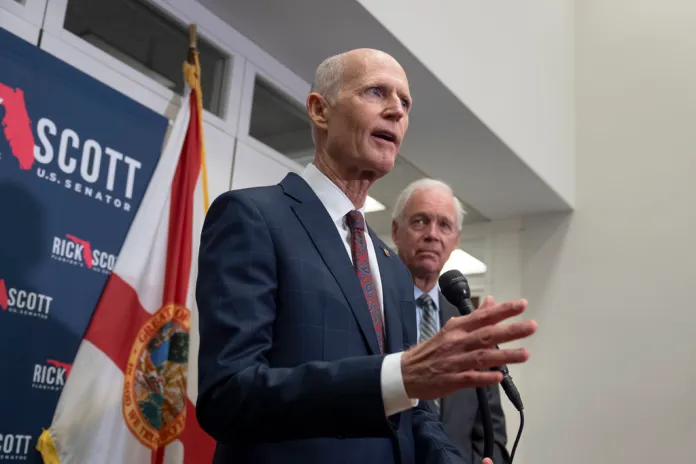
Several Republican senators whose phone records were seized in a 2020 election probe are rejecting taxpayer-funded payouts from a Justice Department fund created to benefit them — even as the Trump administration lobbies hard for the program’s survival.
The Trump administration’s $1.776 billion “anti-weaponization” fund — established through a DOJ settlement resolving Trump’s lawsuit against the IRS over leaked tax records — was designed in part to compensate Republican lawmakers whose phone records were secretly subpoenaed during the Biden-era “Arctic Frost” investigation into efforts to overturn the 2020 election. But some of those targeted senators want no part of it.
Sen. Rick Scott (R-FL), one of the lawmakers whose records were seized, was blunt when asked about accepting a payout. “I don’t need any compensation for that,” he told the Washington Examiner, declining to elaborate on whether other lawmakers should seek funds.
Sen. Ron Johnson (R-WI), whose phone records were also secretly seized and revealed last fall, defended the fund in principle as a deterrent against government abuse — but said he personally “would not apply” for a settlement.
A Fund With Political Toxicity Baked In
The DOJ circulated a memo outlining the fund’s operating details to senators as part of a lobbying push to rescue collapsing negotiations over the GOP’s immigration reconciliation bill. The memo explicitly lists “Senators whose phone records were subpoenaed” among those eligible for compensation. Current and former House Republicans whose records were also targeted would likely qualify as well.
But the fund has become a political liability rather than an asset. Republican-controlled Congress has already rejected similar compensation proposals, and efforts to insert provisions for payouts of up to $500,000 per lawmaker into broader legislation were shot down amid backlash from House Republicans.
The fund’s eligibility for 2021 Capitol rioters has created a significant friction point, complicating the administration’s effort to frame it as a straightforward accountability measure.
Graham Pushes On; Paul Pushes Back
Sen. Lindsey Graham (R-SC), a close Trump ally whose phone records were also subpoenaed, has been the most vocal advocate for compensation on Capitol Hill. His stated rationale: making it “hurt as much as I possibly can” for the federal government, “so nobody will do this again.”
Sen. Rand Paul (R-KY) offered a more skeptical view, suggesting the public had already rendered its verdict on repeated payout attempts. “I think things need to be the same for everyone,” Paul said. “Justice is when things occur that aren’t different for you because you’re in elected office.”
Trump Claims Personal Sacrifice
President Trump defended the fund Friday on Truth Social, framing it as a personal financial sacrifice. “I gave up a lot of money in allowing the just announced Anti-Weaponization Fund to go forward,” he wrote, claiming he could have settled his IRS case “for an absolute fortune.”
The $1.776 billion figure is a deliberate reference to America’s founding 250 years ago. The fund emerged from a settlement of Trump’s lawsuit against the IRS over the leak of his tax returns — a case Scott separately noted he is pursuing against government consulting firm Booz Allen Hamilton over a leak of his own confidential tax records.
The administration’s struggle to sell the fund even to its intended beneficiaries underscores the broader turbulence inside the Senate GOP caucus, where tensions over the reconciliation bill — including a disputed $220 million security allocation for a presidential ballroom not yet built — have strained relations between Republican senators and the White House.