
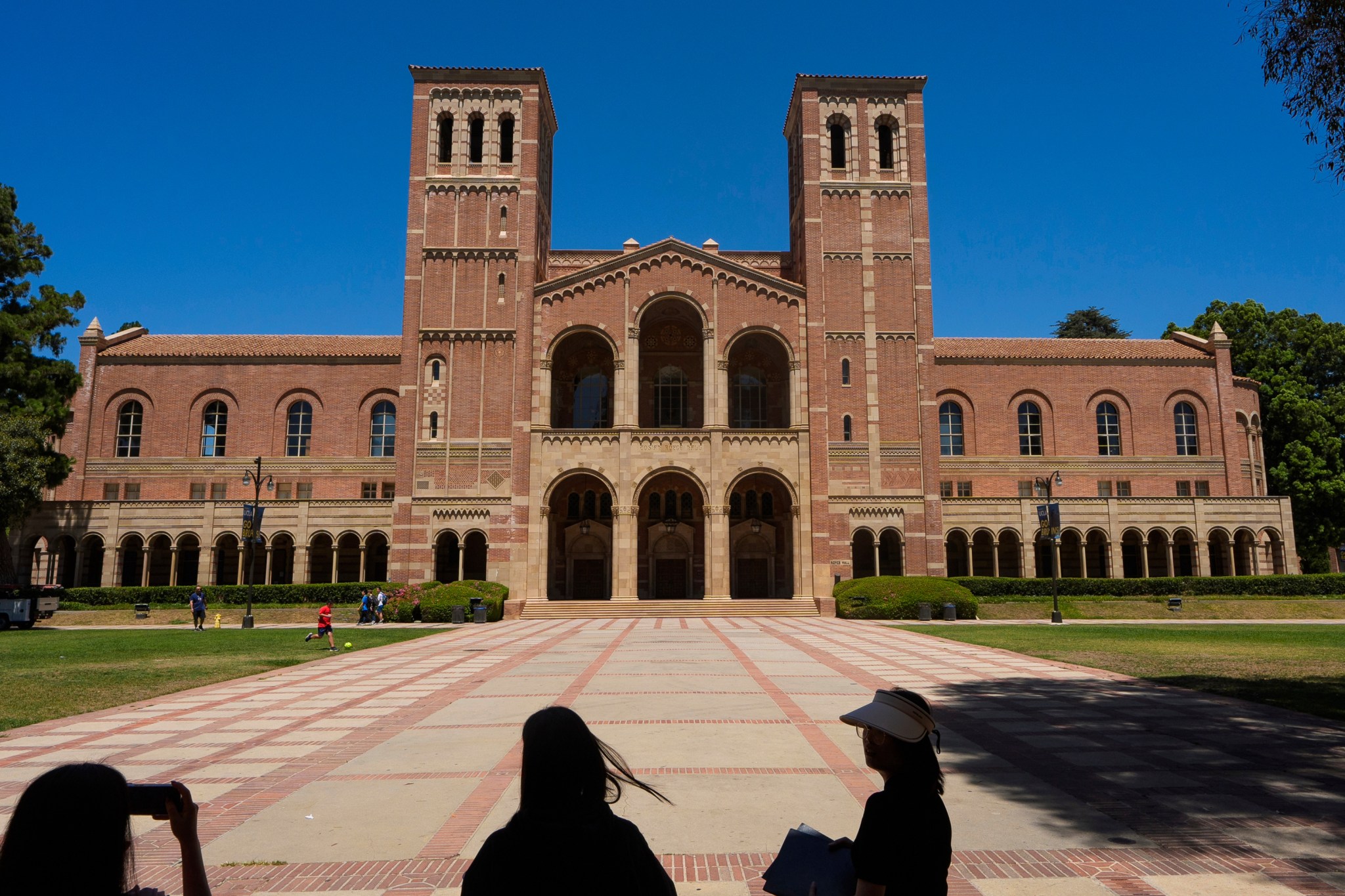
Trump’s Justice Department Finds UCLA Medical School Violated Admissions Law, Threatening Federal Funding
The U.S. Department of Justice announced Wednesday that the David Geffen School of Medicine at UCLA illegally considered race in its admissions process, concluding a year-long investigation that found the school favored Black and Hispanic applicants over white and Asian American candidates in violation of a 2023 Supreme Court ruling.
The finding escalates the Trump administration’s broader campaign against diversity practices at American universities — and marks a significant new front in its ongoing standoff with UCLA, which had previously centered on the main campus’s handling of antisemitic harassment allegations.
“As a result of these practices, highly qualified White, Asian, and other students were denied admission on the basis of their race,” wrote Harmeet Dhillon, head of the DOJ’s Civil Rights Division, in a formal letter of findings.
What the Investigation Found
The Justice Department’s year-long probe cited admissions data from 2023 and 2024 showing that Black and Hispanic students admitted to the medical school had lower average GPAs and test scores than their white and Asian American peers.
Among Black students admitted in 2024, the average GPA was 3.72, compared with 3.84 for Asian Americans and 3.83 for white students. The department argued this disparity constitutes evidence that the school used non-academic factors to achieve racial diversity goals.
Investigators also flagged an application document that invited prospective students to voluntarily disclose whether they belong to a marginalized group and describe its impact — a question included in the 2024 and 2025 application cycles.
UCLA Pushes Back, Pledges Review
The David Geffen School of Medicine denied wrongdoing in a written statement, saying its admissions process is “based on merit” and that it is committed to complying with both state and federal law. The school said it is reviewing the Justice Department’s findings.
California voters banned affirmative action in public university admissions through a 1997 ballot measure. In a brief filed in the 2023 Supreme Court case, the University of California system acknowledged that the ban caused a sharp drop in underrepresented minority enrollment, particularly at its most selective campuses, and said it had since pursued a range of race-neutral strategies to rebuild diversity — with limited success.
Broader Context: A Pattern of Federal Pressure
The UCLA finding is part of a sweeping effort by the Trump administration to police university admissions nationwide. In March, the DOJ opened investigations into possible race-based discrimination in medical school admissions at Stanford University, Ohio State University, and the University of California, San Diego.
The administration has also targeted undergraduate admissions at selective institutions, demanding data demonstrating compliance with the Supreme Court’s 2023 ruling in Students for Fair Admissions v. Harvard, which banned explicit race-conscious admissions policies.
That ruling, however, explicitly permitted colleges to consider how an applicant’s personal background speaks to broader characteristics — a distinction the Trump administration has largely dismissed, treating personal essays and other contextual factors as illegal racial proxies when they touch on race or identity.
What Comes Next
The DOJ finding opens a window for UCLA to reach a voluntary compliance agreement with the department’s legal interpretation. If no resolution is reached, the administration could pursue legal action — including the potential loss of federal funding, a penalty that would be devastating to a major research institution.
The administration’s campaign faces legal resistance. In March, a coalition of 17 Democratic state attorneys general filed a lawsuit challenging the federal policy requiring universities to collect and submit data proving they are not considering race in admissions.
The legal and political battle over what diversity in higher education can lawfully look like — and who gets to define it — is far from over.