
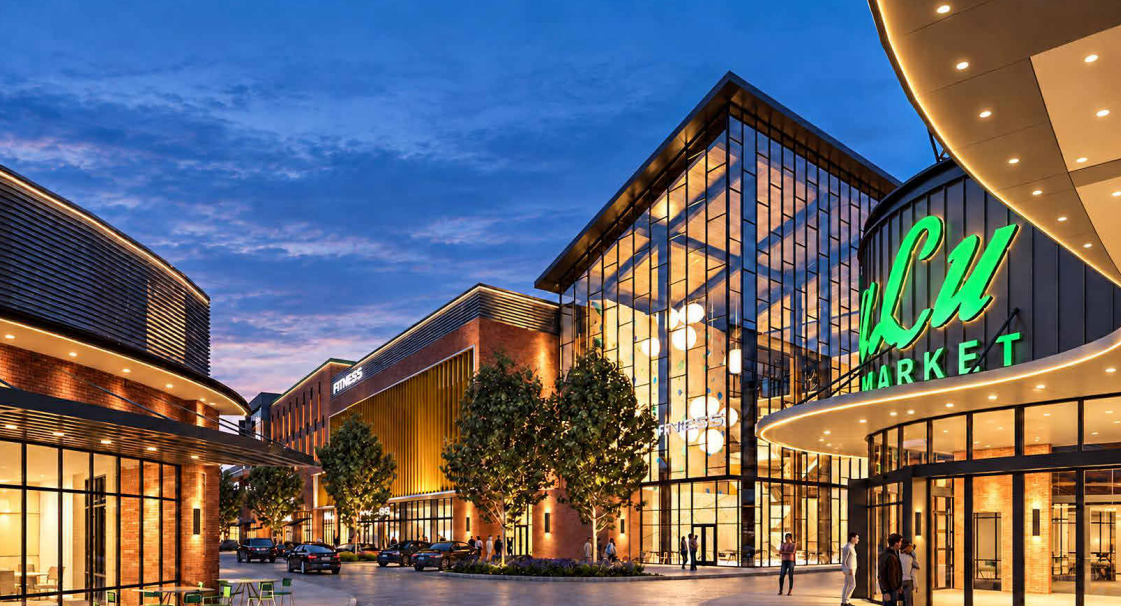
Fulshear, a fast-growing suburb west of Houston, is moving forward with a $520 million plan to build a genuine town center — a pedestrian-friendly mixed-use district designed to give the community something most Texas suburbs conspicuously lack: a place to actually be. The project, known as Fulshear Town Square, would replace the familiar sprawl of strip malls and drive-throughs with walkable streets, public gathering spaces, retail, housing, and a hotel.
The Fulshear City Council has backed the vision, which is being developed in partnership with Johnson Design Group, led by developer Warren Johnson. The site sits near the intersection of FM 1093 and FM 359, a corridor that has seen explosive residential growth over the past decade as Houston’s outer suburbs absorbed waves of new residents priced out of closer-in neighborhoods.
The scale is significant. At half a billion dollars, this is not a speculative rendering or a city council wish list — it represents a serious financial commitment to reshaping how a Texas exurb thinks about public space and urban form. Plans reportedly include a Hallmark Hilton hotel, luxury loft apartments under the Fulshear Village Luxury Lofts banner, and a river walk-style promenade.
Why does this matter beyond Fulshear?
The project reflects a broader tension playing out across Southeast Texas and, frankly, across the American Sun Belt: communities built entirely around the car are now trying to retrofit themselves with the kind of human-scale infrastructure that was never part of the original plan. Fulshear’s bet is that residents want more than a parking lot flanked by chain restaurants.
That instinct is well-founded. Decades of research in urban planning consistently show that walkable, mixed-use neighborhoods generate stronger local economies, produce better public health outcomes, and reduce household transportation costs — benefits that fall disproportionately on working and middle-class families. The strip-mall model, by contrast, primarily serves real estate investors and auto-dependent development patterns that externalize costs onto residents and local governments alike.
City council member Joe Veytia has been among those publicly engaged with the project’s direction, reflecting the degree to which local elected officials are treating this as a defining civic investment rather than a routine zoning approval. Whether the final build delivers on its walkability promises — or quietly reverts to car-centric form once construction economics take over — will be the real test.
Fulshear’s population has grown at a rate that outpaces nearly every comparable municipality in Texas, which gives the town square project both urgency and risk. Build it right, and Fulshear could model something genuinely different for suburban Houston. Build it as a lifestyle-branded version of the same old sprawl, and the $520 million will have bought very little change at all.