
G7 Leaders and AI Executives Push for International Oversight as Trump’s Anthropic Crackdown Alarms Allies
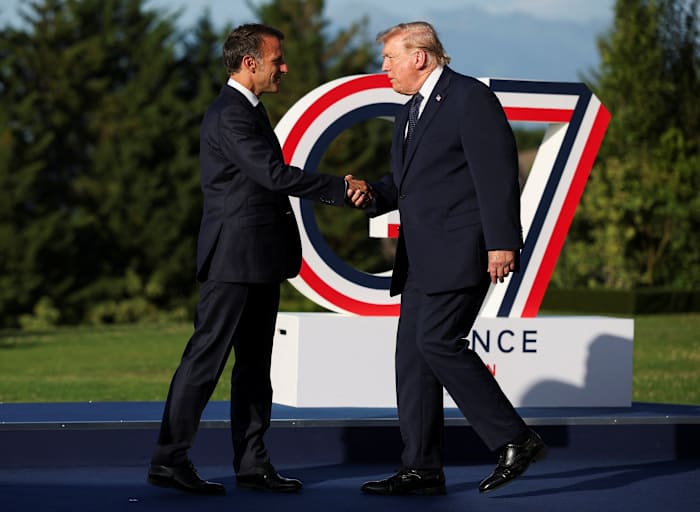
French President Emmanuel Macron called on wealthy democracies to jointly regulate advanced artificial intelligence Wednesday at a high-level G7 summit in France, as the Trump administration’s move to block foreign access to a leading American AI company cast a long shadow over the proceedings.
The meeting brought together heads of state from the Group of Seven industrialized nations alongside the CEOs of some of the world’s most powerful AI companies — including OpenAI’s Sam Altman, Google DeepMind’s Demis Hassabis, and Anthropic’s Dario Amodei — to discuss the “safe, rapid and effective deployment of artificial intelligence.”
But the summit’s cooperative ambitions were immediately complicated by a directive issued last week by the Trump White House, which barred foreign nationals from accessing Anthropic’s newest and most capable AI models, known as Fable 5 and Mythos 5. The company was forced to take both offline to comply.
Macron Criticizes Washington’s “Strictly Nationalist” Approach
Macron acknowledged that U.S. officials were right to treat frontier AI models as potentially dangerous — but said the administration’s unilateral restriction was a “strictly nationalist” reaction that undermined the case for democratic cooperation.
He warned that American AI firms could suffer financially if they begin switching off international access “like a light switch,” eroding trust among allied nations that depend on U.S.-developed systems.
When asked whether G7 nations had pressed the U.S. to restore access to Anthropic’s models, Macron said he made a direct plea for Washington not to hoard cutting-edge AI technology. As a fallback, he announced France would increase domestic AI funding to reduce exposure if international cooperation collapses.
“So let us move forward together,” Macron said. “Our relevant agencies must first cooperate so that, in the areas of security and cybersecurity, we have a smooth government-to-government relationship.”
Altman Calls for an International AI Governance Forum
In remarks to the assembled G7 leaders and more than a dozen AI executives, Altman argued that the technology’s trajectory must be shaped by democratic institutions and society broadly — not left to the companies building the most powerful systems.
“We need an international forum for discussion that establishes globally accepted standards for testing, provides expert and impartial analysis of capabilities and risks, and serves as a venue for cooperation among nations,” he said.
The call was notable given OpenAI’s own complicated relationship with regulation, but it aligned with the summit’s broader push to prevent any single country — or company — from dictating the terms of AI development.
Europe’s Vulnerability Laid Bare
The Anthropic episode crystallized anxieties that had been building in Europe well before the summit. The European Commission this month unveiled a tech sovereignty package aimed at boosting homegrown AI capacity, and Pope Francis last month called for robust international AI regulation.
Zach Meyers, director of research at the Brussels-based think tank CERRE, said Trump’s intervention with Anthropic showed how Europe and other allies “can be put in an extremely vulnerable position” if cut off from advanced AI models.
“There is a general anxiety about the state of Europe, the fact that we’re relying on other countries for quite important strategic infrastructure and a desire to do something about it,” Meyers said.
Aidan Gomez, CEO of Canada’s Cohere AI, told the Associated Press that “a number of proposals” on AI governance were discussed and that the gathering reached a clear, if vague, consensus: “We need something.”
Gomez added that he urged G7 nations to ensure the bloc produces not just the world’s most capable AI — currently a U.S.-China duopoly — but the second most capable as well, a pointed argument for sustained allied investment.
Who Was in the Room
Beyond the major players, the summit also drew Meta’s chief AI officer Alexandr Wang and the heads of smaller national AI labs, including France’s Mistral, Germany’s Black Forest Labs, Italy’s Domyn, Japan’s Sakana AI, and UK-based Synthesia.
Guest nations including Brazil, India, Kenya and South Korea were invited to participate in select discussions, reflecting growing recognition that AI governance cannot remain a club of the wealthiest Western nations.
The G7 comprises France, the United States, Canada, Germany, Italy, Japan and the United Kingdom.