
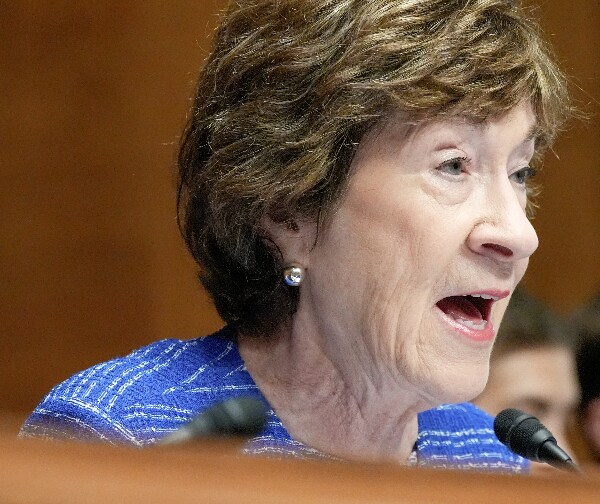
Senator Susan Collins of Maine announced Tuesday that she will vote against President Donald Trump’s nomination of Todd Blanche to serve as attorney general, making her the first Senate Republican to publicly oppose the pick and leaving Blanche with almost no room for further defections from within his own party. Collins’s announcement, first reported by The Hill, came on the same day the Senate Judiciary Committee advanced Blanche’s nomination on a strict party-line vote of 12 to 10, clearing the path toward a full Senate floor vote that Republican leadership hopes to hold before the chamber breaks for its August recess.
Collins did not mince words in her statement. “The Department of Justice has become increasingly political,” she said, acknowledging Blanche’s legal competence while arguing that his tenure as acting attorney general has actively deepened that problem rather than arrested it. Her objections were specific and substantive: Blanche sought to prohibit the mailing of abortion medication, attempted to indict Democratic senators, and earned the formal opposition of more than 1,200 Justice Department employees who argued he has systematically undermined the institution’s independence. She also cited his approval of a settlement between Trump and the Internal Revenue Service over the president’s leaked tax returns — a settlement that created a $1.8 billion “anti-weaponization fund” designed to compensate political allies of Trump who claimed they had been persecuted by the federal government.
That fund had already threatened to derail the nomination entirely. Senators John Cornyn of Texas and Thom Tillis of North Carolina had deadlocked the Judiciary Committee by refusing to vote for Blanche until he confirmed in writing — not merely verbally — that the fund was finished. Blanche ultimately provided that written assurance, and the two senators relented, allowing the committee vote to proceed. Their satisfaction with that arrangement, however, does nothing to resolve the broader concerns that Collins raised, concerns that go to the heart of what kind of Justice Department the Trump administration intends to operate.
A Nomination on the Edge
The arithmetic of the Senate confirmation is now genuinely precarious. With Senator Mitch McConnell of Kentucky still absent following a hospitalization after a fall, Republicans can afford to lose only two votes from their caucus — assuming unified Democratic opposition, which is all but certain. Collins’s announcement means that number has already been spent down to one. Senator Lisa Murkowski of Alaska, who has occasionally broken with the Trump administration on matters of institutional concern, told reporters following the committee vote that she would need “a few more conversations” with Blanche before deciding how to vote. That careful phrasing is not a commitment, and it will concentrate considerable attention on her in the coming days.
Blanche has been serving as acting attorney general since the removal of Pam Bondi in April, and prior to that role he served as Trump’s personal criminal defense lawyer — a background that has itself fueled questions about whether he can exercise the independence the office demands. The Justice Department is not merely another cabinet agency; it wields prosecutorial power over individuals, institutions, and, in principle, the president himself. The fact that more than a thousand of its own career employees formally opposed his nomination is not a routine occurrence and deserves to be treated as the serious institutional signal it represents, rather than dismissed as partisan noise.
Collins’s political position adds a layer of context worth examining honestly. She is the only Republican senator running for reelection in a state that Trump lost, and she is seeking a sixth term against former Maine Senate President Troy Jackson, after Democrats’ original nominee withdrew following allegations of sexual assault. She has broken with the president on several significant votes during his second term, including joining two other Republicans in opposing the so-called One Big Beautiful Bill. It would be easy, and somewhat lazy, to reduce her opposition to Blanche entirely to electoral calculation — but the specific, documented grievances she cited are real, and they stand on their own merits regardless of her reelection calendar. The question of whether the Justice Department retains any meaningful independence from the White House is not a partisan abstraction. It is a structural question about democratic governance, and Collins, whatever her motivations, has answered it clearly.