
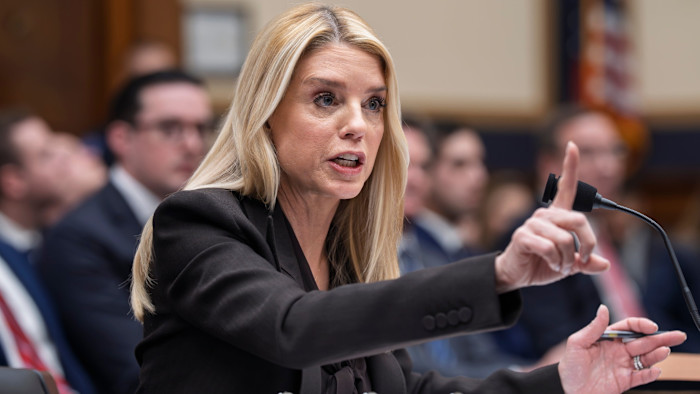
Former Attorney General Testifies Before House Oversight Committee, Blames Deputy for Oversight Failures
Former Attorney General Pam Bondi acknowledged “redaction errors” in the Justice Department’s release of Jeffrey Epstein’s files during a closed-door interview with the House Oversight Committee on Friday — but insisted she is “proud” of the DOJ’s record and claimed the process was handled in “good faith.” The admission comes months after critics accused her team of a chaotic, sloppy release that exposed victims’ identities and buried names of potential co-conspirators.
Bondi, who was fired by President Donald Trump on April 2, appeared before the committee after initially resisting a subpoena. She ultimately agreed to testify voluntarily only after the panel’s top Democrat introduced a resolution to hold her in contempt.
What Went Wrong With the Epstein Files
The Epstein Files Transparency Act required the DOJ to redact only the names and identifying information of victims. Instead, Bondi’s team made a series of significant errors that cut in both directions.
The failures drew condemnation from survivors, legal experts, and lawmakers on both sides of the aisle. Bondi’s defenders framed the problems as bureaucratic missteps in an “enormously complicated and labor-intensive process.” Critics saw a pattern of protecting the connected while failing the vulnerable.
Bondi Points Finger at Todd Blanche
In her prepared opening statement, Bondi distanced herself from direct responsibility. “As the head of a large Department with broad responsibilities, I did not lead every aspect of this effort or conduct that document review myself,” she said, adding that she “delegated oversight over this process to Deputy Attorney General Todd Blanche.”
Rep. Robert Garcia, D-Calif., the top Democrat on the panel, told reporters during a mid-morning break that Bondi had refused to answer any questions about Trump and sought to place blame squarely on Blanche. He quoted her as saying: “Acting Attorney General Blanche was managing the entire investigation.”
Bondi disputed that characterization on social media after leaving the Capitol without speaking to reporters. She wrote that she had “praised Acting AG Blanche’s management of this Herculean task” and called his ethics “beyond reproach.”
Democrats Demand More Accountability — Republicans Set the Terms
The interview was conducted without a formal oath and without video recording — conditions Democrats sharply criticized. Rep. Garcia said the session “should have been under oath, and it should be videotaped.” Rep. James Walkinshaw, D-Va., said the absence of video “contributes to the feeling that Americans have that there’s been a cover-up here.”
In an unusual arrangement, Bondi was accompanied by Assistant Attorney General Harmeet Dhillon and other current DOJ personnel — officials who technically work for the administration that fired her. The DOJ said their presence was to “ensure accurate representation of Department processes.”
Democrats on the panel announced they will subpoena both Blanche and FBI Director Kash Patel, whose name surfaced during Bondi’s testimony. Republicans said they plan to release the interview transcript within days.
Survivors Pushed Aside at the Capitol
Several survivors of Epstein’s abuse gathered outside the Capitol office where the interview was held, attempting to make their presence known as Bondi entered. Multiple survivors said they were shoved aside by police officers.
Dani Bensky, who alleges Epstein sexually abused her as a young ballet dancer, said the improper release of files “sends such a chilling effect to the rest of the survivor community.” She called for the testimony to be filmed and released publicly, warning that a transcript alone loses critical context.
Sharlene Rochard, another Epstein victim, directly confronted committee chair Rep. James Comer before the session began, demanding that all future witnesses testify under oath.
What Bondi Said — and What She Wouldn’t
According to a source familiar with her testimony, Bondi told the committee that Ghislaine Maxwell — Epstein’s convicted accomplice — “should die in prison” and should not receive a pardon, describing her as “evil.” Bondi also said she had no knowledge of Maxwell’s prison transfer.
She declined, however, to answer questions about Trump’s role in directing the handling of the Epstein files. Rep. Maxwell Frost, D-Fla., said he specifically wanted to ask what directives Bondi had received from Trump or others — a line of questioning that remained unanswered.
Bondi closed her opening statement with a line that drew little pushback from Republicans on the panel: “The bottom line is: justice and transparency in this matter have been delivered at the direction of President Trump and his administration.” The claim sits uneasily alongside the documented failures in redaction and the survivors still waiting for accountability.
Background: Epstein, the Investigation, and What Comes Next
Jeffrey Epstein, a billionaire financier and convicted sex offender, died by suicide in a federal detention facility in 2019 while awaiting trial on federal sex trafficking charges. His death — and the handling of his files — has fueled years of public suspicion about the extent of his network and the identities of those who enabled his abuse.
Friday’s session was the 13th interview conducted by the House Oversight Committee in its Epstein probe. Committee chair Rep. James Comer said six more are planned, including one with Bill Gates. Previous interviewees have included Maxwell, Commerce Secretary Howard Lutnick, and Bill and Hillary Clinton.
Bondi disclosed this week that she is currently undergoing treatment for thyroid cancer, diagnosed after she left the Justice Department. She recently underwent surgery as part of her treatment.