
The results are in, and New York Democrats did not waste the opportunity.
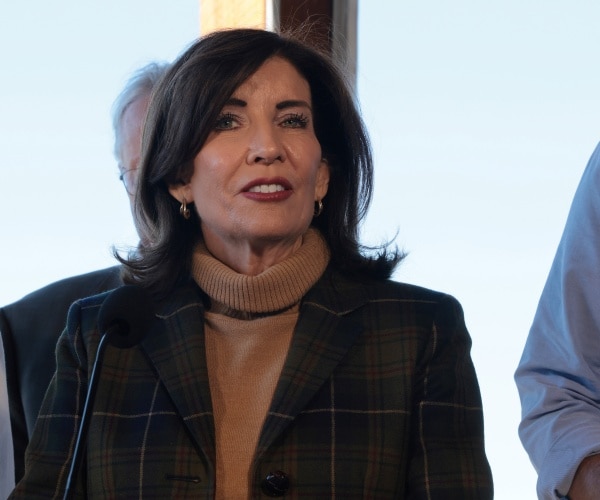
Following a 2023 law signed by Gov. Kathy Hochul that moved a range of local elections from odd-numbered years to even-numbered years, Democrats swept a series of races that Republicans had long held or contested. The wins were not incidental. They were structural, built on a deliberate policy choice that aligned local contests with federal election cycles and the surge in voter participation those cycles reliably produce.
The victories included historic breakthroughs in Hempstead, where Democrats flipped the town supervisor and clerk seats, along with wins in the Erie County clerk race and three legislative seats in Dutchess County. These are not symbolic districts. Hempstead is one of the largest towns in the United States and had been a Republican stronghold for decades. Erie County, home to Buffalo, has been a battleground. Dutchess, long a conservative-leaning county in the Hudson Valley, now has Democratic legislative representation it did not have before.
The mechanics of the shift are straightforward. Local and county elections held in odd-numbered years typically draw a fraction of the electorate that shows up for presidential or congressional races. Low-turnout environments tend to favor organized, motivated minority coalitions, which is precisely why Republicans had benefited from them in many New York localities for years. Moving those contests to even-numbered years floods the zone with voters who otherwise stay home, and in New York, those voters skew heavily Democratic.
The numbers explain why. In New York City alone, registered Democrats outnumber Republicans by roughly 3.5 million to 578,000. But the Democratic advantage does not stop at the city limits. Outside the five boroughs, Democrats hold a 471,000-voter edge statewide and outnumber Republicans in 15 counties, among them Erie, Nassau, Onondaga, Orange, Rensselaer, Rockland, Schenectady, Ulster and Westchester. That is a structural majority that odd-year elections had been effectively suppressing.
Republicans sued to block the law, arguing it required a constitutional amendment and a statewide referendum rather than simple legislation. New York’s Court of Appeals rejected that argument unanimously, ruling the law constitutional and ending the legal challenge. The court’s ruling was a significant defeat for the GOP, which had hoped procedural grounds would do what electoral organizing had not.
The Republican critique centers on the claim that the law was engineered for partisan gain. That framing is not entirely wrong, but it is incomplete. Higher voter turnout is, by most democratic standards, a public good. The question of whether a policy produces partisan advantage and whether it serves the broader democratic interest are not mutually exclusive. Expanding the electorate that participates in local governance is a legitimate goal, even if the party that championed it also benefits from it. Democrats did not invent the correlation between higher turnout and their own electoral success; they simply chose to act on it.
A political science perspective reinforces this reading. Analysts noted that Democrats outperformed even optimistic projections in several of these races, suggesting the calendar shift amplified an already-present Democratic coalition rather than manufacturing one from nothing. The voters were always there. The old calendar just gave them fewer reasons to show up.
Republicans are already warning that 2028 will be worse for them, when a presidential election is expected to drive turnout even higher. That concern is reasonable on its face, but it reflects a strategic problem the party has not yet solved: how to compete in an electorate that, when fully mobilized, does not favor them in New York. Blaming the calendar is easier than rebuilding the coalition.
The law does carry some real-world complications worth acknowledging. Because some local races were moved up in the calendar, candidates who had been elected to two-year terms found themselves facing reelection sooner than the original schedule would have required. That kind of disruption to incumbents’ planning is a legitimate administrative concern, separate from the partisan debate. It also does not apply to New York City offices or to any town or county office with a three-year term, which limits the law’s scope in ways that critics sometimes overlook.
What these results demonstrate, more than anything, is that election administration rules are never neutral. The timing of elections, the placement of polling sites, the structure of registration deadlines, all of these choices shape who participates and who wins. For decades, the odd-year calendar functioned as a quiet suppressor of majority participation in New York local politics. The 2023 law changed that. The 2025 results showed what the majority actually looks like when it votes.